
Direct Answer (TL;DR)
Balcony solar legality in the United States depends on state statutes, utility interconnection rules, and local electrical codes. Pioneer states have enacted explicit plug-in frameworks.
Utah (HB 340, effective May 7, 2025) provides a statutory exemption for systems up to 1,200 W. Colorado (HB26-1007, effective August 12, 2026) allows systems that supply up to 1,920 W to the grid and exempts those of 391 W or less from certain installation and wiring-alteration rules. Maryland (Chapter 353, effective July 1, 2026) establishes a pre-installation notice pathway for systems up to 1,200 W. In states without dedicated plug-in laws, systems default to standard utility interconnection tariffs and require UL 1741 certified anti-islanding microinverters.
Skip to the 50-state wattage table
Balcony solar–often called plug-in solar, mini solar, or Balkonkraftwerk in Europe–is rapidly gaining attention across the United States. For apartment renters, condo owners, and homeowners without accessible rooftops, the concept is compelling. Mount one or two portable panels on a railing, plug into an outdoor receptacle, and immediately offset household base load.
However, the regulatory framework governing plug-in solar in America is fundamentally different from the streamlined national mandates found in Germany, Austria, or France. In the United States, there is no single federal plug-in mandate. Instead, electrical safety follows state and local adoptions of the National Electrical Code (NEC). Grid interconnection falls under state Public Utility Commissions (PUCs) and individual utilities. Meanwhile, tenant installations remain subject to lease agreements and Homeowners Association (HOA) rules.
This guide breaks down model electrical codes, state statutory frameworks, utility interconnection requirements, and compliance steps for 2026.
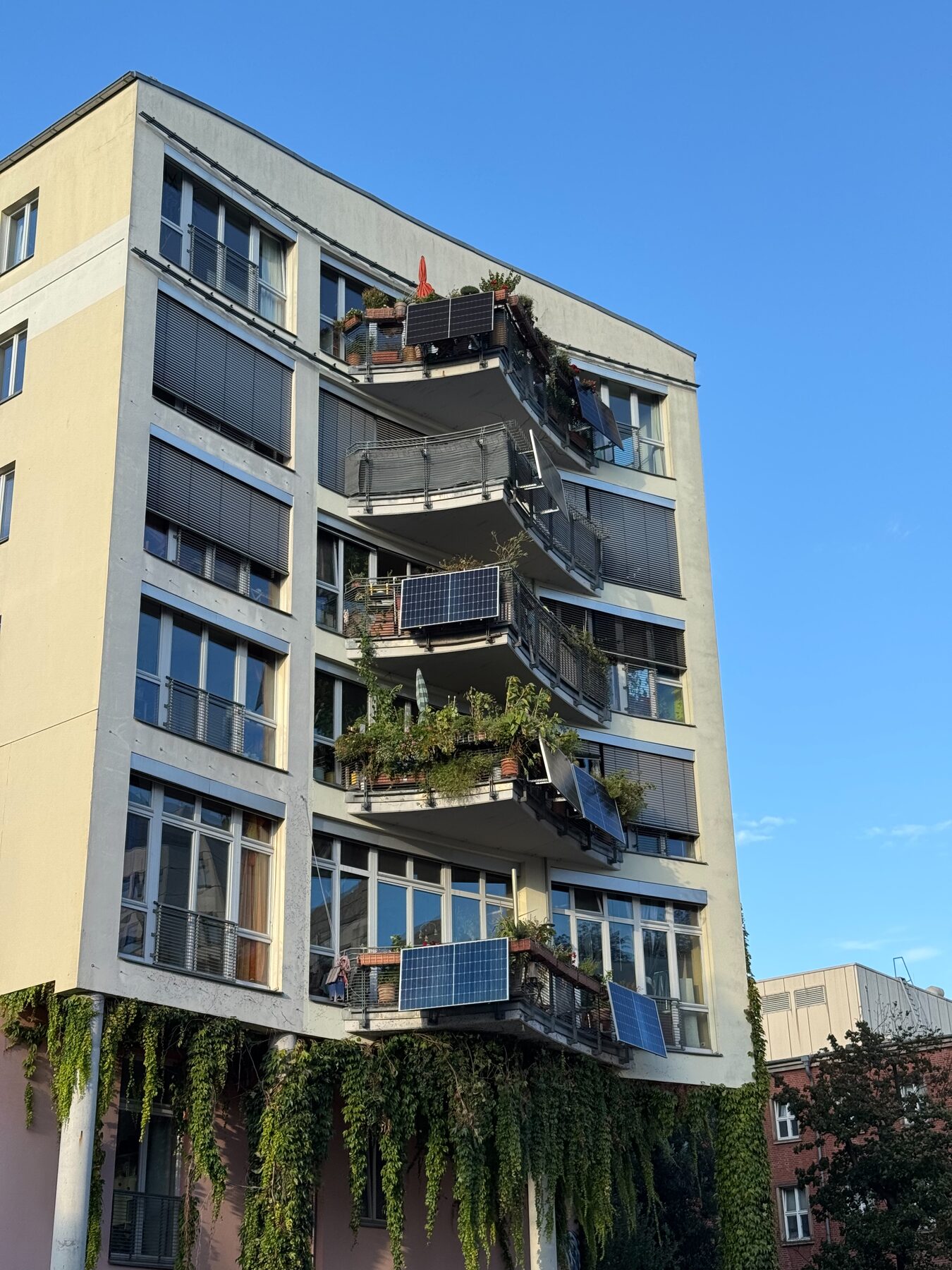
Balcony solar installation mounted to an apartment balcony railing. Photo: Shisma / Wikimedia Commons (CC0).
1. Electrical Safety Codes: NEC Article 705.12 and Branch Circuit Limits
The foundational safety consideration with plug-in solar is how generation backfeeds into a building’s electrical wiring.
The National Electrical Code (NEC) is not a federal statute. It is a model electrical safety code published by the National Fire Protection Association (NFPA). Local Authorities Having Jurisdiction (AHJs) adopt it into law with state-by-state variations.
In a conventional electrical branch circuit, power flows unidirectionally: from the utility transformer through your main service panel breaker, down a branch conductor, to a household load (such as an air conditioner or appliance). The circuit breaker (typically rated at 15 or 20 amperes) protects the conductor from carrying more current than its thermal ampacity allows.
When you connect a plug-in solar device into an ordinary wall receptacle, power enters from the load end of the branch wire.
[Panel: 15A Breaker] ==== 14.7A ====> [Wall Outlet] ==== 18A ====> [Appliances: 18A]
                                            ^
                                            |
                                  [Balcony Solar: 3.3A]
NEC Article 705.12, titled “Load-Side Source Connections”, sets how much a power source may feed into feeders and busbars. It has no rule for a source plugged into a receptacle. The branch-circuit, wiring and overcurrent rules still apply, and the reason a plug-in rule is needed is simple. A plug-in system’s current enters the circuit beyond the breaker, so the wire past the solar outlet carries the breaker’s current plus the solar current:
- Suppose appliances on that stretch of a 15 A circuit draw 18 A while a 400 W system supplies 3.3 A.
- The breaker sees under 15 A and stays closed, but the wire carries 18 A, above the 15 A the NEC allows for 14 AWG household (NM) cable.
For this reason, a proposal for the 2029 NEC would allow a single 360 VA plug-in source on a general-purpose 15 A circuit. UL 3700, published in December 2025, now covers plug-in equipment. State plug-in laws such as Colorado’s also let property owners restrict devices to prevent electrical overload.
2. Inverter Safety Standards: UL 1741 and Anti-Islanding
The second critical technical and legal requirement is inverter certification.
Solar panels generate direct current (DC). Household appliances and the utility distribution grid operate on alternating current (AC). A compact inverter attached to the panel–known as a microinverterMicroinverterA compact inverter attached to an individual solar panel that converts direct current (DC) to household alternating current (AC) at module level. Energy.gov Inverter Overview →–converts DC to AC in synchrony with grid frequency (60 Hz) and voltage (120 V).
Modern microinverters also incorporate MPPTMaximum Power Point Tracking (MPPT)Real-time circuit optimization that dynamically adjusts electrical voltage and current to maximize panel wattage under varying sunlight. MPPT Guide → technology to optimize generation.
Why Anti-Islanding Protection Is Mandatory
If a utility power outage occurs, lineworkers must physically service local distribution lines to restore power. If a customer’s solar generation equipment continues energizing those wires, it creates an electric shock hazard known as an “island.”
Under North American standards (IEEE 1547 and UL 1741):
- Every grid-tied inverter must feature certified anti-islandingAnti-Islanding ProtectionAn automated safety mechanism that stops the inverter energizing the local grid within 2.0 seconds when grid power is lost. Anti-Islanding Safety Guide → protection.
- When grid power collapses, the inverter must cease energizing the circuit within 2.0 seconds.
- Inverters must carry an authentic UL 1741UL 1741 StandardThe definitive North American standard for inverters, converters, and interconnection equipment used with distributed energy resources. UL 1741 Safety Guide → or UL 1741-SB listing from an accredited Nationally Recognized Testing Laboratory (such as UL, CSA, or ETL).
Connecting non-certified inverters to a NEMA 5-15NEMA 5-15 ReceptacleThe standard three-prong 120-volt, 15-ampere grounded electrical outlet found across residential buildings in the United States. Outdoor Outlet Safety Guide → outlet violates electrical codes and utility interconnection tariffs across all states.
3. The 50-State Legislative Landscape
State frameworks for plug-in solar across the United States are evolving rapidly. Nine states have enacted balcony solar laws with dedicated plug-in pathways. Six states and the District of Columbia have a balcony solar bill pending, and in 19 states every bill filed so far failed or stalled:
+--------------------------------------+---------------------------------------------+
| Balcony solar status                 | What it means in practice                   |
+--------------------------------------+---------------------------------------------+
| Balcony solar legal (9 states)       | Enacted plug-in pathways or exemption       |
|                                      | thresholds (CO, CT, MD, ME, NH, NJ, UT, VA, |
|                                      | VT). The CT, NH, NJ and VA laws take effect |
|                                      | between October 2026 and March 2027.        |
| Balcony solar bill pending           | A live bill would create a plug-in pathway  |
| (6 states and DC)                    | (CA, MA, MI, NY, OH, PA, DC). It is not law |
|                                      | yet.                                        |
| Balcony solar bill failed or stalled | Every bill filed failed or stalled (AK, AZ, |
| (19 states)                          | DE, GA, HI, IA, ID, IL, IN, MN, MO, NC, NM, |
|                                      | OK, OR, RI, SC, WV, WY). General            |
|                                      | interconnection rules apply.                |
| No balcony solar law                 | No bill found, or (WA) the bill passed      |
| (16 states, 5 territories)           | without its plug-in part. General           |
|                                      | interconnection rules apply.                |
+--------------------------------------+---------------------------------------------+
Balcony Solar Legal: 9 States with Dedicated Statutes
In states with enacted laws, statutes explicitly establish sub-kilowatt or sub-2 kW categories that streamline or exempt plug-in solar from traditional utility friction:
- Utah (HB 340). Enacted during the 2025 General Session and codified at Utah Code § 54-15-601 (effective May 7, 2025), Utah law creates a category for portable solar generation devices. These are moveable devices with a maximum power output of not more than 1,200 watts, designed to plug into a standard 120 V outlet, and certified by UL or an equivalent nationally recognized testing laboratory. Each must include a feature that stops it energizing the building during a power outage. Qualifying devices are exempt from the statute’s interconnection requirements and from any requirement to enter into an interconnection agreement. An electrical corporation may not require prior approval, fees or extra equipment. The devices are also separated from the statutory net-metering program.
- Colorado (HB26-1007). Signed May 7, 2026, with general provisions effective August 12, 2026 unless a referendum petition was filed (codified at C.R.S. § 40-2-140), Colorado created a category for portable solar devices. Each is a single photovoltaic system per address that supplies no more than 1,920 watts to the grid and is labeled and listed by a nationally recognized testing laboratory. A customer may connect no more than one device to a single wall outlet. Devices of 391 watts or less are also exempt from the state’s solar installation supervision rules and from code or listing provisions that would require alterations to the building’s electrical wiring. Utilities cannot require prior approval, fees or extra equipment, though they may require notice of the device’s presence and size in kilowatts. Statutory protections against unreasonable HOA and property covenant prohibitions commence January 1, 2027.
- Maryland (Chapter 353 / HB 1532). Enacted in 2026 and effective July 1, 2026 (codified at PUA § 7-321), the Utility RELIEF Act requires a customer to notify the electric company before installing a portable solar energy generating system. The system may supply not more than 1,200 watts back to the building, one per electric meter for residential use, and must be certified by UL or an equivalent nationally recognized testing laboratory. A system with 391 watts or less of output to a standard outlet is exempt from product-listing provisions that would require alterations to the building’s premises, wiring or electrical panels. The electric company may not require its approval, fees related to feeding power back, or extra equipment beyond an automatic locking disconnect switch, which the customer pays for if the system requires one.
- Connecticut (HB 5340 / Public Act 26-127). Signed June 4, 2026, and effective October 1, 2026. Section 9 exempts a portable solar generation device with a maximum power output of 1,200 watts, one per customer meter, from interconnection-agreement requirements set by the state regulator. The device must meet the building code, the National Electric Code and IEEE 1547, be certified by UL or an equivalent nationally recognized testing laboratory, and meet UL 1741. It must include a feature that stops it energizing the building during a power outage. It must also carry a warning that excess generation is billed as usage unless the meter allows net metering.
- Maine (LD 1730 / Public Law Chapter 644). Signed April 6, 2026, and effective July 29, 2026, under the title An Act to Make Small Plug-in Solar Generation Devices Accessible for All Maine Residents to Address the Energy Affordability Crisis. Up to 420 watts of combined inverter output per service address, measured in alternating current, needs no electrician. Combined output above 420 watts and up to 1,200 watts is allowed if a Maine-licensed electrician installs each system on a dedicated single-outlet circuit, and the customer notifies the utility within 30 days. Systems must be listed or certified to UL 3700, certified by a nationally recognized testing laboratory to a comparable standard, or configured to the National Electrical Code as adopted by Maine’s Electricians’ Examining Board. They cannot be used for net energy billing. The law also covers plug-in batteries.
- New Hampshire (SB 540 / Chapter 262): Signed into law July 2, 2026; its plug-in provisions take effect January 1, 2027. Its building-code section takes effect when the department of energy certifies that a national standard exists. Each metered customer may use one plug-in solar generation system with a maximum inverter output of 1,200 watts AC. It must be certified by a nationally recognized testing laboratory to meet nationally recognized safety standards for distributed energy resources and plug-in solar generation systems. Utilities may not require approval, interconnection review, extra equipment, or fees other than charges the system incurs through its use.
- New Jersey (S 2368 / P.L.2026, c.82): The “Garden State Balcony Solar Act,” enacted September 1, 2026, and effective March 1, 2027. Devices of up to 1,200 watts need no interconnection agreement or utility approval, and their combined output per service address or dwelling unit may not exceed 1,200 watts without one. A device must be listed or certified by a nationally recognized testing laboratory to UL 3700, a comparable standard or a combination of standards, and must stop exporting power during an outage. Devices with 400 watts or less of output to the receptacle outlet are exempt from listing and code provisions that would require alterations to the building’s premises, wiring or electrical panels. Landlords may not bar a tenant who pays for the electricity from using a device within the leased premises, including a leased balcony or patio, and associations may not enforce bans. Both may set reasonable restrictions on size, placement or manner of placement. A tenant must give them written notice at least 14 days before placement or use, with documentation that the device qualifies and its proposed location. Towns may not require a permit to place or use a device, though building modifications and electrical work still need the usual permits and inspections.
- Virginia (SB 250 / Acts of Assembly Chapter 998): Approved April 22, 2026, and effective January 1, 2027 (codified at Va. Code § 56-596.8 and § 55.1-1212.1). It allows devices of up to 1,200 watts per customer, or per residential building unit in multi-family housing, plugged into an electrical outlet, with no utility approval or fees. The device must meet the National Electrical Code, be certified by a nationally recognized testing laboratory and stop exporting power during an outage. A device with 391 watts or less of output to the receptacle outlet is exempt from product-listing provisions that would require alterations to the building’s premises, wiring or electrical panels. The section does not apply to rental units billed under a ratio utility billing system. The customer submits the form established by the Commission before installation, and the utility has 15 days to respond.
- Vermont (S.202 / Act 149): Signed June 16, 2026, and effective July 1, 2026. Exempts plug-in solar devices with a combined inverter capacity of up to 1,200 watts per electric meter from the Certificate of Public Good (CPG) process and from interconnection agreements. Devices must comply with UL 3700 or an equivalent certification by an equivalent nationally recognized testing laboratory, and be installed and operated in compliance with IEEE 1547-2018 and any successor standard. Devices may only be used with smart meters, and exported power is not paid for. A customer with a net-metering system may not also install one. Municipal zoning bylaws may not regulate the devices, and deed restrictions or covenants may not prohibit them.
Other Legislative Milestones and Active States
- Washington (HB 2296): Approved March 23, 2026, and effective June 11, 2026 (Chapter 136, 2026 Laws). The initial bill draft included plug-in solar provisions, but those sections were stripped before final enactment, leaving Washington without an enacted plug-in solar statutory exemption while policy discussions continue.
- California: California’s Solar Rights Act (Civil Code § 714) and Assembly Bill 2188 protect property owner rights to install solar and streamline permitting. For multi-family housing, exclusive-use balconies may accommodate non-penetrating solar devices, but common-element railings, exterior facades, and leased premises remain subject to landlord permissions and reasonable HOA architectural/safety restrictions. Dedicated plug-in solar legislation, SB 868, passed both houses and was with the Governor as of September 25, 2026.
- Balcony solar bills pending: Six states and the District of Columbia have a live balcony solar bill: California, Massachusetts, Michigan, New York, Ohio, Pennsylvania and the District of Columbia. These bills would advance plug-in solar rights, simplified registration, or tenant solar access.
- Balcony solar bills failed or stalled: In Arizona, Idaho, Indiana, Iowa, Minnesota, Missouri, New Mexico, Oklahoma, Oregon, West Virginia and Wyoming, every balcony solar bill filed so far failed. In Alaska, Delaware, Georgia, Hawaii, Illinois, North Carolina, Rhode Island and South Carolina, the 2026 bills stalled and have not moved since. No balcony solar law is in force in any of these states.
States With No Balcony Solar Law
In states without dedicated plug-in solar legislation, utilities apply their standard distributed generation tariffs regardless of system size. Sizing an 800 W balcony kit in these states typically requires submitting an interconnection application, paying administrative review fees, and verifying that the electric meter is configured for bidirectional measurement.
4. Utility Interconnection and the Meter Problem
Even if your equipment is UL-certified and your city electrical inspector permits the installation, your electrical utility holds jurisdiction over grid interconnection.
The Reverse-Power Meter Risk
Older mechanical electricity meters with spinning aluminum disks literally turn backward when electricity flows out to the street, crediting your bill.
However, modern digital “smart” meters do not automatically spin backward. Depending on how the utility programs your smart meter:
- Bidirectional Metering: The meter records delivered power and received power on separate registers. You receive credit for excess generation based on your utility’s tariff.
- Unidirectional / Detented Mode: The meter measures power flowing in only one direction. If current flows backward from your home toward the grid, the internal electronic detent ignores the export (no credit is given).
- Delivered-plus-received (non-detented) mode: Some meters add energy flowing in either direction to the consumption register; Itron calls this its standard undetented configuration. On these meters, if your 800 W system exports 300 watts continuously for one hour (0.3 kWh), the meter adds that 0.3 kWh to the consumption it records, as if you turned on extra lights. Whether you pay for it depends on how your utility bills from that register.
Before connecting generation equipment, verify that the utility enabled bidirectional metering on the account.
5. Tenant Rights and HOA Solar Rights Acts
For condo owners and apartment renters, property governance often supersedes state utility policy.
Solar Rights Laws vs. Common Elements
Over 25 states have enacted Solar Rights Acts (such as California Civil Code § 714 and Colorado C.R.S. § 38-30-168), which declare that HOAs and property associations cannot prohibit the installation of solar energy devices.
However, Solar Rights Acts virtually always distinguish between exclusive-use property and common elements:
- Exclusive-Use Balcony or Patio: If your lease or deed gives you exclusive control of your balcony interior, an HOA generally cannot enact an outright ban. However, associations may enforce reasonable aesthetic and safety restrictions, such as prohibiting brackets that penetrate the building envelope.
- Exterior Walls and Railings: In many condominiums, the exterior railing and building facade are legally classified as “common elements.” Attaching heavy hardware to a common-element railing without association approval constitutes an unauthorized alteration.
- Rental Leases: Renters do not own the property. Landlords retain legal authority over exterior modifications, window attachments, and electrical usage unless specific municipal tenant-protection laws grant explicit green-device rights.
6. Actionable 5-Step Checklist Before Plugging In
Before purchasing or mounting a balcony solar system, follow this methodical compliance checklist:
- Verify UL 1741 Listing: Inspect the microinverter specification sheet. Confirm it carries a valid UL 1741 or UL 1741-SB certification mark from an accredited laboratory. Reject uncertified hardware.
- Inspect the Target Receptacle: Ensure the outdoor outlet is protected by a Weather-Resistant (WR) enclosure, an in-use extra-duty weatherproof cover, and a functioning Ground Fault Circuit Interrupter (GFCI) per NEC 406.9(B).
- Review Your Lease or HOA Rules: Verify that your mounting method does not penetrate exterior walls, compromise waterproofing, or violate railing safety codes (such as fall-hazard clearance above sidewalks).
- Check Your State Status on BalconySolar.org: Use our interactive map and state comparison tool to review active statutes, bill numbers, and local limits.
- Contact Your Utility: Inquire whether your service address has a bidirectional smart meter installed and ask for their simplified interconnection form for sub-kilowatt generation.
Frequently Asked Questions
Can a utility detect an unnotified balcony solar installation?
Yes. Depending on how the utility programs your meter, exported power may be recorded separately, ignored, or added to your consumption, and some meters report reverse power flow to the utility. A utility that sees unexpected readings may investigate or send a technician to inspect the meter. The plug-in laws in Utah, Colorado and Maryland bar the utilities they cover from requiring prior approval; Colorado’s lets it require notice, and Maryland’s requires the customer to notify it.
Can my landlord evict me for installing balcony solar?
If your lease prohibits unauthorized electrical modifications or hanging objects from balcony railings, installing a system without written consent can constitute a lease violation. Always obtain written landlord approval for mounting hardware and electrical connections.
Does plug-in solar work during a power outage?
Standard grid-tied microinverters do not work during a blackout. Anti-islanding safety protocols force the inverter to shut down within 2.0 seconds when the grid fails. To run appliances during an outage, you need a specialized system with an off-grid transfer switch or a portable battery power station equipped with dedicated solar inputs.
7. 50-State Wattage Table
The table below lists every U.S. state and territory with verified alternating-current wattage limits, governing bills, tier conditions, and effective dates. Entries not yet cross-checked against a primary source are marked “Not yet verified”.
| State | Status | Bill | Min W | Max W | Tiers | Effective |
|---|---|---|---|---|---|---|
| Alabama | No balcony solar law | - | Not yet verified | Not yet verified | Not yet verified | Not yet verified |
| Alaska | Balcony solar bill failed | HB 257 | 1200 | 1200 | Not yet verified | Not yet verified |
| Arizona | Balcony solar bill failed | HB 2843 | 1200 | 1200 | Not yet verified | Not yet verified |
| Arkansas | No balcony solar law | - | Not yet verified | Not yet verified | Not yet verified | Not yet verified |
| California | Balcony solar bill pending | SB 868 | 1200 | 1200 | Not yet verified | Not yet verified |
| Colorado | Balcony solar legal | HB26-1007 | 391 | 1920 | 391 W - exemption within the 1,920 W category, not a separate cap: exempt from C.R.S. 40-2-128 installation requirements and from code or product listing provisions that would require rewiring; 1920 W - maximum output to the grid; a single labeled and listed system per address, one device per wall outlet | 2026-08-12 |
| Connecticut | Balcony solar legal | HB 5340 | 1200 | 1200 | Not yet verified | 2026-10-01 |
| Delaware | Balcony solar bill failed | SB 270 | 800 | 800 | Not yet verified | Not yet verified |
| Florida | No balcony solar law | - | Not yet verified | Not yet verified | Not yet verified | Not yet verified |
| Georgia | Balcony solar bill failed | HB 1304 | 1200 | 1200 | Not yet verified | Not yet verified |
| Hawaii | Balcony solar bill failed | SB 2902 | 1200 | 1200 | Not yet verified | Not yet verified |
| Idaho | Balcony solar bill failed | H 612 | Not yet verified | Not yet verified | Not yet verified | Not yet verified |
| Illinois | Balcony solar bill failed | HB 4524 | 1200 | 1200 | Not yet verified | Not yet verified |
| Indiana | Balcony solar bill failed | HB 1084 | 1200 | 1200 | Not yet verified | Not yet verified |
| Iowa | Balcony solar bill failed | HF 2046 | Not yet verified | Not yet verified | Not yet verified | Not yet verified |
| Kansas | No balcony solar law | - | Not yet verified | Not yet verified | Not yet verified | Not yet verified |
| Kentucky | No balcony solar law | - | Not yet verified | Not yet verified | Not yet verified | Not yet verified |
| Louisiana | No balcony solar law | - | Not yet verified | Not yet verified | Not yet verified | Not yet verified |
| Maine | Balcony solar legal | LD 1730 | 1200 | 1200 | Not yet verified | 2026-07-29 |
| Maryland | Balcony solar legal | HB 1532 | 391 | 1200 | 391 W - output to a standard electrical outlet of 391 W or less: exempt from product-listing provisions that would require premises, wiring or panel alterations | 2026-07-01 |
| Massachusetts | Balcony solar bill pending | H.5175 | Not yet verified | Not yet verified | Not yet verified | Not yet verified |
| Michigan | Balcony solar bill pending | HB 5764 | 1200 | 1200 | Not yet verified | Not yet verified |
| Minnesota | Balcony solar bill failed | SF 4504 | Not yet verified | Not yet verified | Not yet verified | Not yet verified |
| Mississippi | No balcony solar law | - | Not yet verified | Not yet verified | Not yet verified | Not yet verified |
| Missouri | Balcony solar bill failed | HB 2444 | Not yet verified | Not yet verified | Not yet verified | Not yet verified |
| Montana | No balcony solar law | - | Not yet verified | Not yet verified | Not yet verified | Not yet verified |
| Nebraska | No balcony solar law | - | Not yet verified | Not yet verified | Not yet verified | Not yet verified |
| Nevada | No balcony solar law | - | Not yet verified | Not yet verified | Not yet verified | Not yet verified |
| New Hampshire | Balcony solar legal | SB 540 | 1200 | 1200 | Not yet verified | 2027-01-01 |
| New Jersey | Balcony solar legal | S 2368 | 400 | 1200 | 400 W - output to the receptacle outlet of 400 W or less: exempt from listing, NEC and construction-code provisions that would require premises, wiring or panel alterations | 2027-03-01 |
| New Mexico | Balcony solar bill failed | SB 157 | 1920 | 1920 | Not yet verified | Not yet verified |
| New York | Balcony solar bill pending | S.8512 | 1200 | 1200 | Not yet verified | Not yet verified |
| North Carolina | Balcony solar bill failed | HB 1129 | 1200 | 1200 | Not yet verified | Not yet verified |
| North Dakota | No balcony solar law | - | Not yet verified | Not yet verified | Not yet verified | Not yet verified |
| Ohio | Balcony solar bill pending | SB 383 | Not yet verified | Not yet verified | Not yet verified | Not yet verified |
| Oklahoma | Balcony solar bill failed | HB 4060 | 1200 | 1200 | Not yet verified | Not yet verified |
| Oregon | Balcony solar bill failed | HB 4080 | Not yet verified | Not yet verified | Not yet verified | Not yet verified |
| Pennsylvania | Balcony solar bill pending | HB 1971 | 1200 | 1200 | Not yet verified | Not yet verified |
| Rhode Island | Balcony solar bill failed | H 7269 | 1200 | 1200 | Not yet verified | Not yet verified |
| South Carolina | Balcony solar bill failed | H 4579 | Not yet verified | Not yet verified | Not yet verified | Not yet verified |
| South Dakota | No balcony solar law | - | Not yet verified | Not yet verified | Not yet verified | Not yet verified |
| Tennessee | No balcony solar law | - | Not yet verified | Not yet verified | Not yet verified | Not yet verified |
| Texas | No balcony solar law | - | Not yet verified | Not yet verified | Not yet verified | Not yet verified |
| Utah | Balcony solar legal | HB 340 | 1200 | 1200 | Not yet verified | 2025-05-07 |
| Vermont | Balcony solar legal | S.202 | 1200 | 1200 | Not yet verified | 2026-07-01 |
| Virginia | Balcony solar legal | SB 250 | 391 | 1200 | 391 W - output to the receptacle outlet of 391 W or less: exempt from product-listing provisions that would require premises, wiring or panel alterations | 2027-01-01 |
| Washington | No balcony solar law | HB 2296 | Not yet verified | Not yet verified | Not yet verified | 2026-06-11 |
| West Virginia | Balcony solar bill failed | HB 5648 | Not yet verified | Not yet verified | Not yet verified | Not yet verified |
| Wisconsin | No balcony solar law | - | Not yet verified | Not yet verified | Not yet verified | Not yet verified |
| Wyoming | Balcony solar bill failed | HB 146 | Not yet verified | Not yet verified | Not yet verified | Not yet verified |
| State | Status | Bill | Min W | Max W | Tiers | Effective |
|---|---|---|---|---|---|---|
| American Samoa | No balcony solar law | - | Not yet verified | Not yet verified | Not yet verified | Not yet verified |
| District of Columbia | Balcony solar bill pending | B26-0602 | Not yet verified | Not yet verified | Not yet verified | Not yet verified |
| Guam | No balcony solar law | - | Not yet verified | Not yet verified | Not yet verified | Not yet verified |
| Northern Mariana Islands | No balcony solar law | - | Not yet verified | Not yet verified | Not yet verified | Not yet verified |
| Puerto Rico | No balcony solar law | - | Not yet verified | Not yet verified | Not yet verified | Not yet verified |
| U.S. Virgin Islands | No balcony solar law | - | Not yet verified | Not yet verified | Not yet verified | Not yet verified |
Disclaimer: This article provides educational information on electrical codes, standards, and legislation. It does not constitute formal legal or engineering advice. Always consult a qualified licensed electrician and review local municipal codes and utility tariffs before installing electrical generation equipment.