
Direct Answer (TL;DR)
Certified plug-in solar inverters cannot shock you when unplugged because they require a live utility voltage reference to generate alternating current. Under IEEE 1547-2018IEEE 1547-2018The national standard governing interconnection and interoperability between distributed energy resources and electric power systems.IEEE Standard Overview → and UL 1741UL 1741The North American product safety standard for distributed generation inverters, converters, and interconnection system equipment.UL Standards Directory → standards, microinverters feature automated anti-islandingAnti-Islanding ProtectionA mandatory safety mechanism that de-energizes inverter AC output within milliseconds whenever utility grid power drops or the plug is disconnected.IEEE 1547 Specifications → protection.
The circuitry ceases power export in less than 2.0 seconds during grid failures and typically disconnects in 16 to 30 milliseconds when unplugged. Dual independent relays open the circuit and internal bleeder resistors discharge output capacitors to safe levels below 30 V before the metal prongs clear the wall outlet faceplate. Certified hardware protects utility line workers from backfeed and prevents shocks for renters and homeowners.
The single most frequent question from prospective balcony solar owners, skeptical landlords, and municipal electrical inspectors concerns electrical backfeed:
What happens if you pull the solar plug while bright midday sunlight hits the panels? Will live electricity arc across the metal prongs and shock your fingers? Will the panels backfeed the neighborhood grid during a blackout and electrocute utility line workers repairing wires down the street?
The short, definitive answer verified by laboratory physics and electrical code is no.
A certified grid-tied microinverter cannot produce electrical power in the absence of a stable utility grid signal. The instant physical contact with a wall receptacle breaks, the inverter de-energizes its terminals.
This guide explains the electrical engineering, standards testing, and firmware mechanisms that make certified plug-in solar intrinsically safe against shock and backfeed.
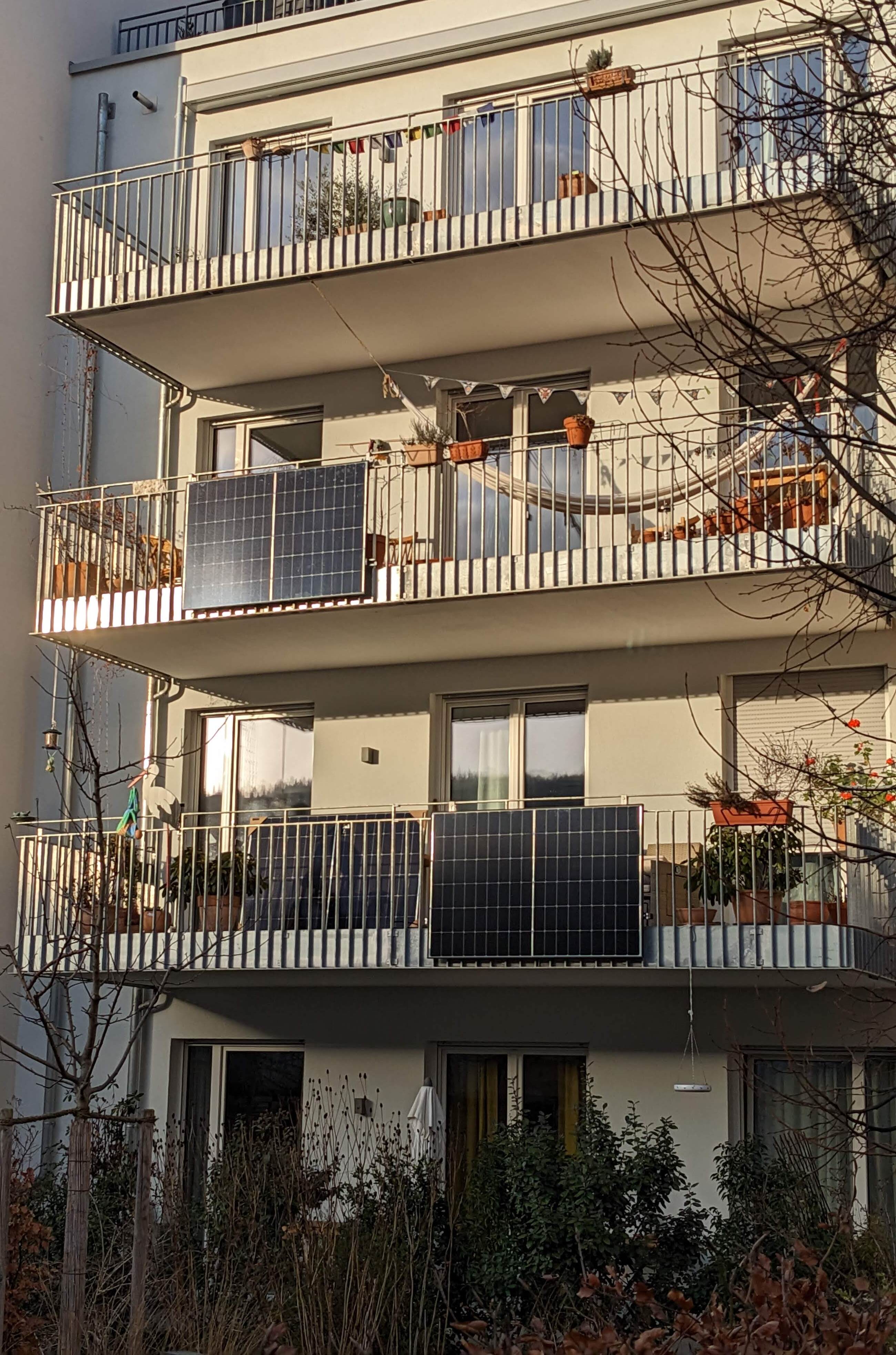 Certified microinverters undergo rigorous anti-islanding testing under UL 1741 and
IEEE 1547 to verify automatic disconnection during grid loss. Photo:
BalconySolar.org.
Certified microinverters undergo rigorous anti-islanding testing under UL 1741 and
IEEE 1547 to verify automatic disconnection during grid loss. Photo:
BalconySolar.org.
1. The root of the fear: why backfeed is dangerous
Electric utility safety guidelines treat unauthorized generation with intense caution for sound historical reasons.
During utility power outages, storms often knock down high-voltage distribution lines. Linemen working on de-energized wires depend on physical grounding clamps and verified circuit disconnects to prevent electrocution.
Traditional fuel-powered portable generators present a severe backfeed hazard if connected to household wiring without an automatic transfer switch. A portable 120 V or 240 V generator can push current backward through the household service panel and into the street transformer. The transformer functions in reverse, stepping 120 V back up to 7,200 V or 14,400 V on neighborhood lines.
This lethal hazard is known in utility engineering as unintentional islanding. An island forms when an isolated section of the electrical distribution grid remains energized by a local generator while disconnected from the central utility source.
Because portable generators are grid-forming voltage sources, they manufacture their own independent AC voltage sine wave. They will happily energize a dead power line until their fuel runs out or their circuit breaker trips.
Certified plug-in solar systems operate on the exact opposite electrical principle.
2. Grid-forming vs. grid-following inverters
To understand why balcony solar cannot backfeed a dead power line, you must distinguish between two fundamentally different classes of power electronics:
- Grid-forming inverters: Found in whole-home backup batteries (such as the Tesla Powerwall) and off-grid solar cabins. These inverters synthesize their own voltage and frequency reference. They can establish an isolated electrical island, but they require a heavy, mechanically interlocked automatic transfer switch (ATS) at the main meter to physically disconnect the home from the utility grid before turning on.
- Grid-following inverters: The microinverters used in standard balcony solar kits (including systems from Hoymiles, APSystems, Enphase, TSUN, EcoFlow, and Anker). These devices are current sources, not voltage sources. They cannot manufacture an independent voltage waveform. Instead, they act like electronic mirrors. They monitor the existing 120 V, 60 Hz sine wave delivered by the utility power company and inject synchronized current into that existing wave.
If the utility grid voltage disappears, a grid-following microinverter has no template to follow. Its internal control loops lose phase synchronization, and power generation collapses instantly.
Think of a grid-following microinverter like a tandem bicycle rider sitting in the rear seat. The rear rider can push pedals to add forward power only while the front rider steers and balances the bicycle. If the front rider steps off the bike, the rear rider cannot steer or balance alone. The bike halts immediately.
3. How anti-islanding circuitry works: passive and active detection
Modern microinverter safety relies on two independent layers of anti-islanding surveillance running simultaneously in the onboard microprocessor: passive detection and active perturbation.
Passive monitoring: voltage and frequency trip windows
Passive protection continuously samples the incoming AC voltage and frequency at the wall outlet dozens of times per electrical cycle.
Under the IEEE 1547-2018 standard, every grid-tied inverter must maintain strict operating boundaries. For a standard North American 120 V, 60 Hz electrical service, standard clearing thresholds include:
- Under-voltage: If line voltage drops below 88 V (0.88 per unit), the inverter must cease to energize the grid within 1.0 s. For severe drops below 50 V, shutdown occurs in less than 160 ms.
- Over-voltage: If line voltage rises above 132 V (1.10 per unit), the inverter must trip within 1.0 s. For surges exceeding 144 V, disconnection occurs in under 16 ms.
- Under-frequency: If grid frequency slows below 58.5 Hz, the inverter trips in less than 300 ms.
- Over-frequency: If grid frequency accelerates above 61.2 Hz, shutdown occurs within 300 ms.
When you unplug a balcony solar kit from the wall, the sensed voltage instantly drops from 120 V to 0 V. This triggers the severe under-voltage threshold in less than one single alternating-current cycle (16.7 ms at 60 Hz).
Active detection: breaking the resonant island
What happens in the rare theoretical scenario where an unplugged solar kit is connected to a local load that perfectly balances panel output?
For example, imagine an 800 W balcony system powering an 800 W space heater on the same isolated cord. Could the local load consume all generated power, keeping local voltage at 120 V and local frequency at 60 Hz without utility assistance?
To prevent this theoretical balance, UL 1741 and IEEE 1547 mandate active anti-islanding techniques, most commonly Sandia Frequency Shift (SFS) or Active Frequency Drift (AFD).
The microinverter firmware constantly introduces a minute, imperceptible phase perturbation into its output current. It nudges the current waveform slightly ahead of the voltage waveform.
When connected to the massive regional utility grid, this tiny nudge does nothing. The immense physical inertia of giant spinning turbines and hundreds of power plants pins the grid frequency immovably at 60.00 Hz.
However, the instant the utility connection breaks, that stabilizing grid inertia disappears. The microinverter’s deliberate phase nudge immediately feeds back into its own voltage sensing circuitry.
Within two to three cycles, the electrical frequency destabilizes and spirals rapidly away from 60 Hz. The passive frequency window trips, shutting down power in tens of milliseconds.
Active anti-islanding ensures that even in an engineered laboratory test bench with matched resistors, inductors, and capacitors, a certified microinverter cannot sustain an island.
4. Hardware disconnects: dual relays and bleeder resistors
Anti-islanding is not merely a software routine that halts transistor switching. Certified inverters back up digital controls with dual physical isolation relays.
Inside every certified microinverter, alternating current passes through two independent, series-connected electromechanical isolation relays (referred to in European electrical standards as NA-Schutz or network and system protection relays).
Both relays must receive continuous active drive signals from separate microprocessor channels to remain closed. If software hangs, if a microcontroller resets, or if grid sensing fails, the relay coils lose power and spring open, creating a physical air gap between the solar panels and the wall plug.
In addition, inverter output filter capacitors smooth the AC sine wave. If an appliance cord is pulled from an outlet, stored electrostatic energy in filter capacitors could theoretically deliver a minor shock if touched immediately.
To eliminate this touch-voltage risk, standards require automated discharge circuits. Heavy-duty bleeder resistors drain the capacitors to a safe potential below 30 V in a fraction of a second.
The European standard for plug-in solar appliances, DIN VDE V 0126-95, explicitly mandates that the pin contacts of a disconnected plug must discharge to below 34 V AC within 200 ms after separation.
Top microinverters certified to UL 1741 and VDE standards accomplish this discharge in 16 ms to 30 ms–far faster than a human hand can pull a three-prong plug out of an outlet.
Once unplugged, the metal prongs carry zero electrical charge.
5. The 30-millisecond sequence: what happens when you pull the plug
To visualize the speed of modern anti-islanding safety, consider the chronological timeline when a user pulls a balcony solar plug from a receptacle:
- T = 0 ms: The metal prongs of the NEMA 5-15 plug begin sliding out of the outlet contacts. Physical contact is broken.
- T = 1 ms: Sensed line voltage drops to zero. The microinverter phase-locked loop (PLL) loses its reference sine wave.
- T = 2 ms: The digital signal processor shuts down the pulse-width modulation (PWM) gate drive signals to the switching MOSFET or IGBT power transistors. Active power generation stops.
- T = 16 ms to 25 ms: High-speed electromechanical relays physically snap open, introducing a physical mechanical air gap.
- T = 30 ms: Internal bleeder resistors discharge output filter capacitors to below 30 V.
- T = 100 ms: The user’s hand finishes pulling the plug free of the outlet. The metal prongs are completely de-energized and cold.
Compare this 30 ms timeline to a standard human eye blink, which takes between 100 ms and 400 ms. A certified microinverter de-energizes its plug three to ten times faster than you can blink.
6. Regulatory standards: UL 1741, UL 1741-SB, and IEEE 1547
When purchasing or inspecting balcony solar equipment in the United States, look for specific regulatory certification listings on the manufacturer cut-sheet:
- UL 1741: The foundational standard titled Inverters, Converters, Controllers and Interconnection System Equipment for Use With Distributed Energy Resources. Section 46.3 specifies the rigorous anti-islanding test protocol. Testing laboratories connect the inverter to a resonant RLC load bank tuned to match the inverter’s full rated output. The utility breaker is opened, and the inverter must demonstrate complete shutdown within 2.0 s across multiple power levels and load combinations.
- UL 1741-SA / UL 1741-SB: Modern smart inverter standards. These standards mandate advanced grid-support capabilities (such as voltage ride-through, frequency ride-through, and soft ramp rates) required by major utilities in California (Rule 21), Hawaii (Rule 14H), and across regional ISO grids. Even with grid ride-through enabled, UL 1741-SB smart inverters preserve strict loss-of-mains anti-islanding trip times during genuine power outages.
- IEEE 1547-2018: The technical benchmark adopted by the Federal Energy Regulatory Commission (FERC) and state public utility commissions governing grid interconnection. Section 8.1 dictates anti-islanding performance requirements.
- NEC 705.12: The National Electrical Code section regulating point of connection and busbar ratings. Certified inverters backfeed branch circuits safely without exceeding panel ampacity limits.
For a comprehensive review of state-by-state plug-in solar policies and statutory capacity caps, consult our guide to 2026 state balcony solar laws.
7. Verifying equipment: how to confirm certification marks
Not every solar product sold on online marketplaces meets North American electrical codes. Inexpensive off-grid inverters and uncertified direct-import kits may lack anti-islanding protection and pose severe fire and shock hazards.
To verify that your microinverter is certified safe:
- Look for an accredited NRTL mark: Ensure an accredited Nationally Recognized Testing Laboratory issued the mark. Recognized marks include UL (Underwriters Laboratories), CSA (Canadian Standards Association), and ETL / Intertek. A generic “CE” logo represents manufacturer self-declaration, which US electrical inspectors reject.
- Check the exact standard citation: The product nameplate or data specification sheet must explicitly state UL 1741 or UL 1741-SB alongside IEEE 1547.
- Verify the NRTL directory: You can verify certification claims directly in the online certification directories of UL Product iQ or the Intertek ETL Directory.
- Confirm integrated ground fault protection: Certified microinverters include integrated GFDI (Ground Fault Detection and Interruption) under NEC 690.41, preventing dangerous DC ground faults from energizing panel frames or balcony railings.
To learn more about connecting your kit to outdoor receptacles, review our detailed guide on outdoor outlet plug-in solar safety.
Frequently Asked Questions
If I pull the solar plug and touch the prongs instantly, will I feel an electrical tingle?
No. Certified microinverters cease power production and discharge their output capacitors in 16 ms to 30 ms. Because human physical motion is far slower than electronics, the prongs are de-energized before they clear the receptacle socket.
Can balcony solar power my refrigerator during a utility blackout?
Standard grid-tied balcony solar kits cannot power appliances during an electrical blackout. Because they require an external utility voltage reference to operate, anti-islanding circuitry shuts them down instantly when grid power drops.
To maintain power during an outage, you must use a solar kit paired with an island-capable portable power station or a dedicated battery storage system featuring an isolated emergency backup circuit.
What documentation satisfies landlord or HOA shock concerns?
Share the manufacturer specification sheet showing the UL 1741 and IEEE 1547 marks. Certified inverters de-energize prongs within milliseconds. Reference our renter balcony solar landlord guide and HOA solar rules guide.
Does overpanelling a microinverter affect its anti-islanding response speed?
No. Adding higher-wattage solar panels to a microinverter (overpanelling) increases DC energy yield during mornings and cloudy weather, but the inverter AC output stage remains capped at its continuous rating (e.g. 800 W).
The anti-islanding microprocessor and electromechanical disconnect relays operate on the AC output stage, responding to utility voltage loss at the exact same millisecond speed regardless of DC panel wattage. Read our balcony solar overpanelling guide for complete electrical sizing guidelines.
Primary Statutory and Technical References
- UL 1741 Standard: Inverters, Converters, Controllers and Interconnection System Equipment for Use With Distributed Energy Resources, Underwriters Laboratories, Edition 3, 2021. UL Standards Sales Directory.
- IEEE 1547-2018: IEEE Standard for Interconnection and Interoperability of Distributed Energy Resources with Associated Electric Power Systems Interfaces, IEEE Standards Association, Section 8.1 (Unintentional Islanding), 2018. IEEE Xplore Standards.
- National Electrical Code (NEC): NFPA 70, Articles 705.12 (Load-Side Source Connections), 705.13 (Power Control Systems), and 690.41 (Ground Fault Protection), National Fire Protection Association, 2023. NFPA Code Portal.
- DIN VDE V 0126-95: Automatic disconnection device between a generator and the public low-voltage grid, German Commission for Electrical, Electronic & Information Technologies of DIN and VDE, 2024. VDE Standards.