
Direct Answer (TL;DR)
In most US states, renters cannot install balcony solar against explicit lease prohibitions or if mounting hardware penetrates building facades or alters common elements. However, tenants who occupy exclusive-use balconies and use zero-drill, non-penetrating hardware face fewer restrictions. Laws in Colorado (HB26-1007) and New Jersey (S 2368) limit landlord bans on qualifying plug-in systems from 2027. Virginia’s SB 250 does the same for landlords who own more than four rental dwelling units, or more than a 10 percent interest in more than four. Tenants must give written notice at least 14 days ahead in New Jersey, and notice at least seven days ahead in Virginia. In Vermont (Act 149), a tenant gives at least 10 days’ notice and may proceed if the landlord does not respond within 10 days, but may not do electrical work without the landlord’s permission. In Europe, Germany’s Solarpaket I eliminated landlord vetoes entirely by classifying balcony solar as a privileged legal right under civil law. US tenants maximize approval by presenting property managers with proof of UL 1741UL 1741The North American safety standard for distributed generation inverters, certifying rapid automated shutdown during grid outages.UL 1741 Safety Guide → certification, zero-drill clamps, and personal liability insurance.
Renting an apartment historically locked households out of solar energy. Traditional rooftop installations require building ownership, long-term capital investments, structural modifications, and complex utility interconnection queues.
Balcony solar changes the physical equation. A self-contained kit hangs from a railing, collects daylight, and plugs directly into a standard outdoor outlet.
Yet physical feasibility does not eliminate legal friction. When renters ask whether they can plug in without landlord approval, they confront a maze of property law, lease covenants, condominium declarations, and local electrical regulations.
This guide analyzes tenant rights, statutory precedents across US states, European regulatory breakthroughs, non-damaging mounting methods, and a step-by-step negotiation strategy for apartment residents.
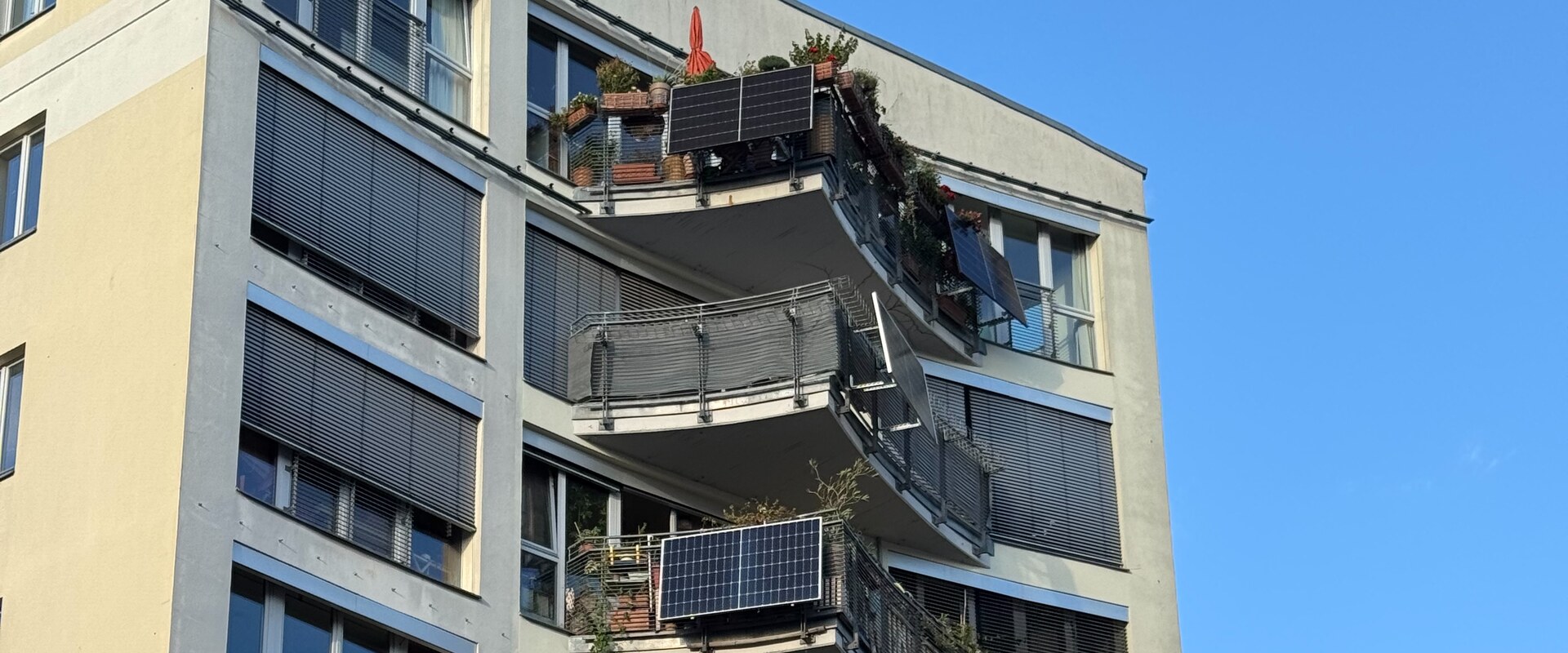 Urban residential apartment balconies. Balcony solar gives tenants direct access to
clean energy when mounted safely without structural property modifications. Photo:
Wikimedia Commons (CC0).
Urban residential apartment balconies. Balcony solar gives tenants direct access to
clean energy when mounted safely without structural property modifications. Photo:
Wikimedia Commons (CC0).
1. Property Rights: Exclusive-Use Balconies vs. Common Elements
Property classifications determine landlord authority over balconies. Leases and condominium bylaws separate multi-family properties into three physical zones:
- Demised Interior Premises: The interior living space described in your lease contract. Tenants maintain quiet enjoyment and control over everyday furnishings, appliances, and decor.
- Exclusive-Use Common Areas: Spaces outside the interior walls reserved exclusively for one unit’s occupants, such as private balconies, patios, and assigned terraces.
- General Common Elements: Shared structural components, including exterior building facades, roofs, hallways, stairwells, and outer railings.
+------------------------+---------------------------------+---------------------------------+
| Property Zone          | Typical Fixtures                | Tenant Installation Rights      |
+------------------------+---------------------------------+---------------------------------+
| Interior Premises      | Furniture, desktop electronics  | Complete tenant discretion      |
| Exclusive Balcony      | Planters, patio chairs, mats    | Allowed if non-penetrating      |
| Exterior Building Wall | Masonry, siding, common facade  | Strict landlord veto authority  |
+------------------------+---------------------------------+---------------------------------+
The Demised Boundary and Security Deposits
Most residential leases restrict property alterations. Standard lease covenants prohibit drilling, driving screws, painting, or attaching permanent fixtures to exterior walls, railings, or roofs without prior written consent.
Violating this covenant gives landlords legal grounds to serve cure-or-quit notices or withhold security deposits for stucco and concrete repairs.
However, hanging a lightweight assembly using padded clamps without drilling does not modify the structure. Courts frequently treat removable, clamped railing attachments similarly to privacy screens, hanging planters, or patio umbrellas rather than permanent fixtures.
2. State Solar Access Laws and Plug-in Statutes
In the United States, property law historically favored property owners and homeowners associations (HOAs). However, several state legislatures have begun extending solar access rights to tenants and plug-in systems.
Colorado (HB26-1007)
Colorado established a statutory framework for plug-in solar energy devices. Under HB26-1007:
- A device is a single photovoltaic system per address that supplies up to 1,920 W to the grid and is labeled and listed by a nationally recognized testing laboratory. No more than one may be connected to a wall outlet, and utilities may not require approval or a fee. Devices of 391 W or less are also exempt from the solar photovoltaic installation requirements of C.R.S. 40-2-128 and from code or listing provisions that would require alterations to the building’s electrical wiring.
- From January 1, 2027, no person may unreasonably prohibit the installation, use or operation of a device, and covenants that do so are void.
- A property owner may still require reasonable restrictions, including prior notice of installation and rules on fire or electrical overload, damage or harm, and the device’s location.
Maryland (Chapter 353 / HB 1532)
Maryland’s Chapter 353 of 2026 sets utility rules for portable solar systems that supply up to 1,200 W back to the building:
- The electric company may not require approval, fees related to feeding power back, or extra equipment. The one exception is an automatic locking disconnect switch, which the customer pays for if the system requires one.
- The customer must notify the electric company before installation and certify the system’s safety features and maximum capacity.
- The act does not address landlords or leases, so tenants should not read it as overriding a lease or building rule.
California (Civil Code §§ 714 and 714.1)
California’s landmark Solar Rights Act restricts HOAs and property owners from banning solar energy systems:
- Section 714 voids any covenant or lease restriction that effectively prohibits solar installation.
- Section 714 allows only reasonable restrictions. For a photovoltaic system, a restriction that adds more than $1,000 to the cost or cuts efficiency by more than 10% is not reasonable.
- Section 714.1 lets an association restrict systems in common areas and require installers to indemnify or reimburse it for damage, but not adopt a general ban on rooftop systems for household use. It places no insurance duty on renters.
Utah (HB 340)
Utah enacted HB 340 to exempt portable solar devices up to 1,200 W from utility interconnection applications and fees. The act also requires a feature that stops the device energizing the building during an outage, and places the devices outside the net-metering program. It does not address landlords or tenants.
Check your state’s current legal framework using our interactive legislation map and state comparison tool. Read our statutory guide Is Balcony Solar Legal in My State for detailed bill numbers.
3. The European Counter-Model: Germany’s BGB § 554
American renters face fragmented state rules. By contrast, Germany resolved tenant solar access through federal legislation that eliminated landlord veto authority.
Under the federal Solarpaket ISolarpaket IGerman landmark federal energy reform simplifying balcony solar registration, raising limits to 800 W, and establishing tenant installation rights.BMWK Energy Policy → initiative, the German parliament amended two core statutes:
- Civil Code (BGB § 554): Granted balcony solar “privileged measure” status (privilegierte Maßnahme), placing it in the same protected legal category as disability ramps, fire exits, and EV charging points.
- Condominium Act (WEG § 20): Barred homeowners associations and condominium boards from blocking solar panels on apartment railings.
Under German law, landlords cannot issue blanket refusals. A tenant informs the owner in writing, and the landlord must consent unless they prove extraordinary hardship, severe structural impairment, or historic landmark protection (Denkmalschutz).
A landlord objecting simply because “panels look unattractive from the street” violates federal law. This legal protection unlocked over one million active systems across German rental units.
4. Hardware Safety: Zero-Drill Mounting and Electrical Protection
If you install balcony solar in a rental property, selecting appropriate hardware prevents lease disputes and protects your security deposit.
Non-Penetrating Mounting Hardware
Never drill into balcony railings, masonry walls, or concrete floors. Three non-penetrating mounting designs satisfy building codes without damaging property:
- Over-Rail Clamp Hooks: Heavy-duty stainless steel hooks loop over top railing bars, secured with rubber-cushioned backing plates and vibration-resistant locking nuts.
- Secondary Steel Safety Lanyards: High-tensile stainless steel aircraft cables wrap around load-bearing structural posts. If a primary clamp fails, the cable prevents the panel from falling.
- Freestanding Ballasted Floor Consoles: Weighted A-frame tubs rest on the balcony floor, ballasted with concrete pavers or gravel. They require zero railing contact and leave no marks.
Electrical Safeguards and Microinverters
Landlords frequently raise concerns regarding electrical fires and shock hazards. You can resolve these concerns using certified components:
- Certified Anti-Islanding: Grid-tied kits require a microinverterMicroinverterA compact device attached to a solar panel converting direct current into synchronized alternating current for wall outlets.Energy.gov Inverter Guide → listed under UL 1741. Inverters incorporate anti-islandingAnti-IslandingAn automated safety mechanism that halts power output within 200 milliseconds if grid voltage drops.UL 1741 Anti-Islanding Guide → circuitry, which ceases power export within milliseconds if utility grid power fails. The plug prongs are electrically dead the instant you unplug them.
- Branch Circuit Protection: Standard household outlets run on 15A or 20A breakers with 14 AWG or 12 AWG copper wire. An 800 W microinverter injects 6.67A at 120V. In states with retail net meteringNet MeteringA billing arrangement crediting distributed generation owners for electricity exported back to the utility grid.DSIRE Clean Energy Database →, this generation offsets daytime baseline consumption smoothly.
For electrical guidelines on system capacity and economics, consult our detailed analysis on How to Size a Balcony Solar System.
5. How to Request Landlord Permission: The Professional Proposal
Approaching a landlord casually often triggers an automatic refusal driven by fear of fire, structural damage, and tenant liability.
Presenting a written, professional installation packet preempts these objections. Deliver a proposal containing these four elements:
- Specification Sheet: Include manufacturer documentation confirming UL 1741 and IEEE 1547 listing for the microinverter.
- Mounting Plan and Photographs: Provide close-up diagrams showing rubberized, zero-drill railing clamps and secondary safety tethers. Confirm that no screws or anchors touch the building.
- Restoration Guarantee: State in writing that the entire system detaches within thirty minutes upon lease termination, leaving the railing in its original condition.
- Certificate of Insurance: Attach a copy of your tenant renters insurance policy showing active personal liability coverage ($300,000 to $500,000 standard limit).
Sample Landlord Proposal Letter
Dear [Property Manager or Landlord Name],

I am writing to request permission to place a portable, non-penetrating balcony solar device on the private railing of Unit [Number].

To address common property questions in advance:
1. Zero Structural Alteration: The assembly uses padded, non-drill railing clamps and secondary aircraft-grade safety lanyards. No screws, bolts, or adhesives penetrate building walls, stucco, or railings.
2. Electrical Certification: The equipment utilizes a UL 1741-listed microinverter with automatic anti-islanding protection, disconnecting electrical current within milliseconds if unplugged.
3. Code Compliance: The system operates at [400 W / 800 W], injecting less than 7A onto the outdoor GFCI circuit, well within standard 15A branch ratings.
4. Liability Coverage: My active renters insurance policy includes $500,000 in personal liability coverage.
5. Immediate Removal: The hardware is completely portable and detaches cleanly upon move-out without leaving any residue or marks.

I have attached the equipment cut-sheets, mounting schematics, and insurance certificate for your records. Thank you for your time and support for clean energy.

Sincerely,
[Your Name]
Unit [Number]
Frequently Asked Questions
Can a landlord evict a tenant for installing balcony solar?
A landlord cannot evict a tenant without serving formal notice and establishing a material lease violation. If your lease does not prohibit railing attachments and the hardware causes zero damage, courts rarely consider removable equipment grounds for eviction. However, if your lease explicitly bans exterior attachments, defying a written cure notice can jeopardize your tenancy.
Can an HOA or condo board overrule my landlord?
Yes. If you rent a condominium or an apartment within an HOA community, master deed restrictions and HOA rules bind all residents, including tenants. Even if your landlord agrees, an HOA can issue fines for exterior architectural violations unless state law protects the installation. For state-by-state solar rights and Architectural Review Committee defense strategies, consult our dedicated guide on HOA and Condo Board Balcony Solar Rules.
Does balcony solar damage railing finishes?
Standard mounting brackets feature thick EPDM rubber pads or silicone sleeves that isolate metal clamps from painted railings. Installing secondary safety lanyards ensures mechanical redundancy without scratching powder-coated surfaces.
What happens to the system when my lease ends?
Balcony solar hardware is fully portable. You unplug the microinverter, loosen the clamp thumb-screws, detach the safety cables, and pack the modules in under an hour. You take your power plant to your next home.
Conclusion and Next Steps
Renting does not prevent solar savings. Selecting UL-listed hardware, choosing non-invasive mounts, and presenting clear safety documentation enable tenants to generate clean electricity safely.
To determine how much power an apartment setup produces at your address, enter your electric bill into our Household Sizing Simulator. If you plan an oversized panel array to boost winter output, review our complete Balcony Solar Overpanelling Guide.