
Direct Answer (TL;DR)
State solar access lawsSolar Access LawsState statutes that void private deed covenants and association bylaws that prohibit or unreasonably restrict solar energy systems.DSIRE Solar Access Database → limit how far an HOA or condo board can restrict solar, but their reach on balconies varies. Statutory protections in California, Colorado, Florida and Texas void blanket community bans on renewable energy devices. They do not all reach an exclusive-use common areaExclusive-Use Common AreaPortions of an association property reserved for the sole possession of an individual resident, such as a private balcony or assigned patio.CAI Community Guide →. Florida’s law does not apply to patio railings in condominiums, cooperatives or apartments, and Texas lets an association bar devices on property it owns, maintains or holds in common. The Maryland law bars unreasonable limits on solar collectors on roofs and exterior walls the owner owns or has exclusive use of, and associations may restrict common areas.
State statutes void aesthetic restrictions that boost equipment costs or degrade solar production beyond statutory thresholds, including California’s limit on efficiency losses of more than ten percent. Condominium owners must avoid penetrating exterior walls or shared roofs without association consent. Using zero-drill clamp brackets, UL 1741 microinverters, and anti-glare panels ensures complete compliance with community bylaws.
Millions of American homeowners and condominium residents live in communities governed by a Homeowners Association (HOA) or Condominium Association.
When residents decide to install plug-in solar panels on a sunny balcony, the board often issues a quick denial. Association managers cite strict aesthetic rules, uniform exterior guidelines, or prohibitions against architectural changes.
These automatic refusals are frequently unenforceable. Over twenty-five US states have passed statutory solar access protections. These laws explicitly strip associations of the power to ban clean energy hardware.
Understanding your property rights turns an intimidating board dispute into a straightforward approval. This legal guide analyzes state statutes, explains condominium common elements, outlines California’s statutory 10% efficiency threshold, and provides an Architectural Review Committee application strategy.
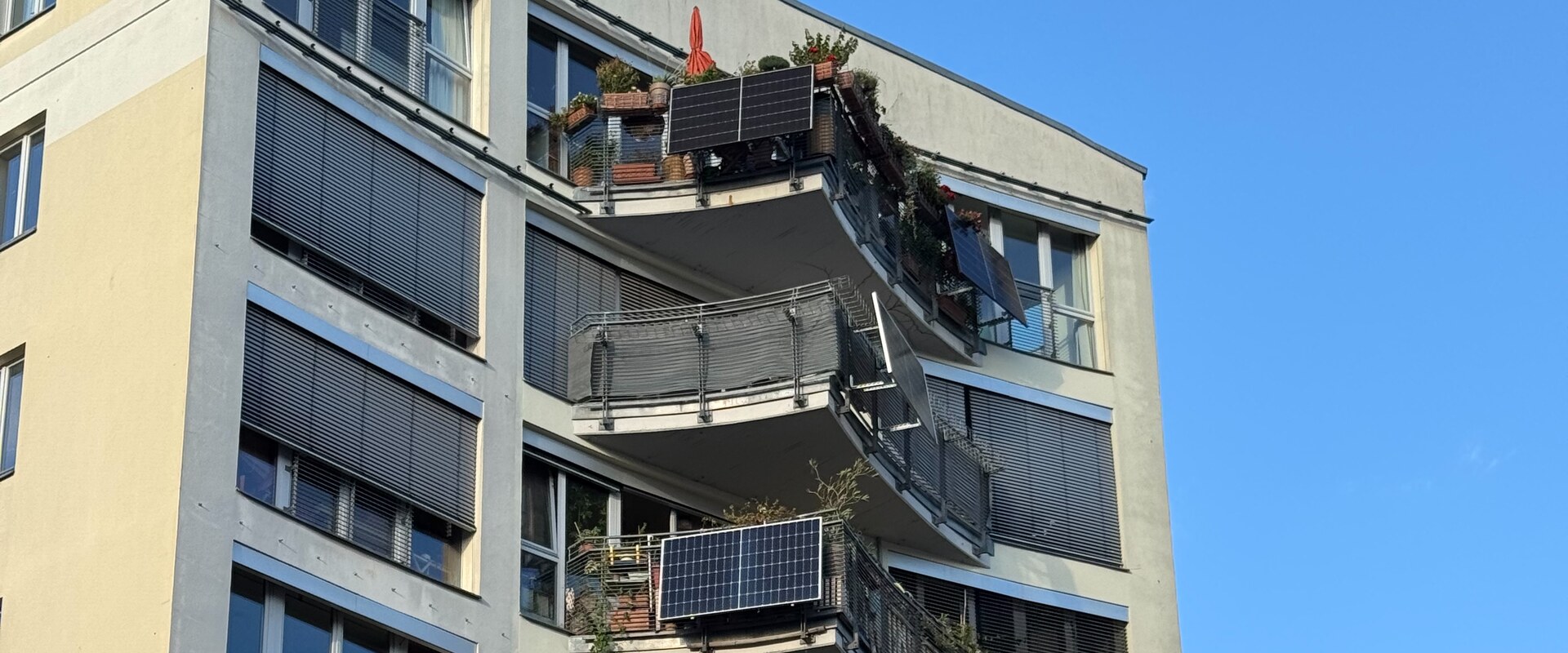 Private condominium and apartment balconies. State solar access laws protect
non-penetrating solar installations in exclusive-use spaces against arbitrary HOA
bans. Photo: BalconySolar.org.
Private condominium and apartment balconies. State solar access laws protect
non-penetrating solar installations in exclusive-use spaces against arbitrary HOA
bans. Photo: BalconySolar.org.
1. The legal hierarchy: State solar access laws vs. HOA covenants
Every common-interest community operates under recorded declarations known as CC&RsCovenants, Conditions, and RestrictionsLegally binding deed restrictions governing property use, architectural standards, and maintenance duties in an association.Community Associations Institute → (Covenants, Conditions, and Restrictions).
Association boards enforce these rules through an Architectural Review CommitteeArchitectural Review Committee (ARC)An association committee that evaluates owner requests for exterior modifications against community architectural guidelines.ARC Procedures Guide → (ARC). Typical CC&Rs require written permission before altering exterior surfaces. Many older declarations even forbid hanging items from balcony railings.
However, private contracts cannot override public state law:
[State Statutory Laws & Energy Codes] (Supreme Authority)
                  |
                  v
[Recorded Master Deeds & Declaration of CC&Rs]
                  |
                  v
[HOA Board Bylaws & ARC Guidelines]
                  |
                  v
[Informal Board Decisions & Manager Opinions] (Lowest Authority)
When a state legislature passes a solar access statute, that law creates an absolute public policy preemption. Any clause in recorded CC&Rs that contradicts state law is legally void and unenforceable.
If your state protects renewable energy systems, an HOA cannot enforce a blanket ban on balcony solar.
2. State-by-state preemption statutes and cost ceilings
State laws protect distributed solar with specific legal standards and financial ceilings:
California (Civil Code §§ 714 and 714.1)
California established the benchmark for solar protections under the landmark Solar Rights Act.
Under Section 714, any covenant, restriction, or deed condition that effectively prohibits or restricts the installation or use of a solar energy system is void.
The statute defines reasonable restrictions strictly. An association rule is void if it:
- Increases total solar system installation costs by more than $1,000 for photovoltaic systems, per California Civil Code Section 714.
- Decreases system performance by more than 10%, per statutory efficiency limits.
Under Section 714.1, associations may regulate common areas. However, owners of separate interests with exclusive-use balconies retain the right to install systems that meet building codes.
In Tesoro del Valle Master Homeowners Assn. v. Griffing, California appellate courts confirmed that associations bear the legal burden of proving their restrictions do not violate Section 714 thresholds.
Colorado (C.R.S. § 38-30-168 and HB26-1007)
Colorado revised statute C.R.S. § 38-30-168 voids any covenant, restriction or condition in a deed or similar instrument “that effectively prohibits or restricts the installation or use of a renewable energy generation device”.
An association may keep aesthetic provisions that reasonably restrict a device’s dimensions, placement or appearance, as long as they do not:
- Increase the cost of the device by more than 10%, per Colorado Revised Statutes.
- Decrease its performance or efficiency by more than 10%.
- Take more than 60 days to review; an application not denied or returned within 60 days is deemed approved.
Bona fide safety requirements also stand, and the statute gives no right to place a device on a limited or general common element of a common interest community.
The Colorado legislature expanded these protections under HB26-1007. The statute covers a single photovoltaic system per address that supplies no more than 1,920 W to the grid and is labeled and listed by a nationally recognized testing laboratory. Devices of 391 W or less are also exempt from the solar photovoltaic installation requirements of C.R.S. 40-2-128 and from code or listing provisions that would require alterations to the building’s electrical wiring.
From January 1, 2027, the law voids covenants or restrictions that explicitly or indirectly unreasonably prohibit or restrict a portable device. It also lets an owner in a common interest community install one on a limited common element. Reasonable restrictions remain allowed, including prior notice and rules on fire or electrical overload, damage and location.
Florida (Florida Statute § 163.04)
Florida Statute § 163.04 prohibits any governing entity or association declaration from banning solar collectors or other renewable energy devices.
The statute grants associations limited authority over placement:
- An association may determine the specific location on the roof where solar collectors are installed.
- The designated location must face south or within 45 degrees east or west of due south, per Florida Statute 163.04.
- The alternate location cannot impair the operational efficiency of the solar system.
The statute does not apply to patio railings in condominiums, cooperatives or apartments, so it gives no right to mount panels on them.
Texas (Texas Property Code § 202.010)
Texas Property Code § 202.010 bars a property owners’ association from prohibiting or restricting an owner’s installation of a solar energy device, and voids provisions that do.
The statute then lists cases in which an association may still prohibit a device, including:
- A device on property the association owns or maintains, or on property its members own in common.
- A device anywhere other than the roof of the home or a fenced yard or patio the owner owns and maintains, or one taller than that fence line.
- A roof device outside the area the association designates. The owner may use another roof location only if it raises estimated annual energy production by more than 10 percent, using a public National Renewable Energy Laboratory modeling tool, per Texas Property Code 202.010.
- A device installed without the association’s prior approval, where a dedicatory instrument requires it.
The statute does not mention balconies. Unless a balcony counts as a fenced patio the owner owns and maintains, it is outside the protected locations.
Maryland (Real Property § 2-119 and Chapter 353)
Maryland Real Property Code § 2-119 bars restrictions that impose unreasonable limitations on installing a solar collector system on a roof or exterior wall that the owner owns or has the exclusive use of.
Maryland sets numeric limits on association interference under Maryland Real Property Section 2-119:
- A restriction is unreasonable if it raises the installation cost by at least 5%.
- A restriction is unreasonable if it cuts the energy generated by at least 10%.
- An association may still prohibit or restrict installations in common areas.
Maryland’s separate Chapter 353 of 2026 (HB 1532) sets the utility rules for portable solar systems that supply up to 1,200 W back to the building, one per electric meter for residential use. It bars the electric company from requiring approval. The customer must notify the electric company before installation, certify the system’s safety features and maximum capacity, and pay for an automatic locking disconnect switch if the system requires one. It does not address associations.
Other protected states
Several other states enforce statutory protections against association bans:
- Arizona (A.R.S. § 33-1816): Bars a planned community association from prohibiting the installation or use of a solar energy device, per Arizona Revised Statutes Section 33-1816.
- Illinois (765 ILCS 165/): The Homeowners’ Energy Policy Statement Act voids deed restrictions and covenants that prohibit solar energy systems on buildings subject to a homeowners’, common interest community or condominium unit owners’ association. An association’s choice of configuration on a roof face may not reduce production by more than 10%, per 765 ILCS 165/20.
- Virginia (Va. Code § 55.1-1820.1): Prohibits community associations from banning solar energy systems unless the recorded declaration contains an express prohibition, per Virginia Code Section 55.1-1820.1.
- Washington (RCW 64.38.055): Bars governing documents from prohibiting a solar energy panel on the owner’s or resident’s property, per Revised Code of Washington 64.38.055. Associations may still set rules on visibility, roof slope, paint, shielding, indemnification and other reasonable placement, and the section does not apply to common areas.
- North Carolina (G.S. § 22B-20): Renders void any deed restriction that effectively stops solar installation on residential property, per North Carolina General Statutes Section 22B-20.
Check your state’s enacted rules using our state comparison tool or read our statutory summary Is Balcony Solar Legal in My State.
3. Condominiums vs. single-family HOAs: The common element boundary
Understanding your property classification prevents legal missteps:
Single-family homes and townhomes
In single-family HOA communities, homeowners own their home, exterior siding, and patio in fee simple. The association holds maintenance easements and enforces aesthetic rules, but owns zero physical interest in your balcony.
In these communities, state solar access laws apply with maximum force. An HOA cannot prohibit panels on your patio or private balcony railings.
Condominium unit ownership
Condominium ownership separates multi-unit buildings into three distinct legal categories:
- The Demised Unit Interior: The interior cubicle of air and interior drywall surfaces owned exclusively by the unit titleholder.
- General Common Elements: Shared building elements owned in undivided interest by all owners, such as the building roof, foundation, elevators, hallways, and exterior facade walls.
- Limited or Exclusive-Use Common Elements: Exterior spaces owned collectively but deeded for the private, exclusive use of one unit, such as private balconies, patios, and assigned parking spaces.
+------------------------------------+------------------------------------+
| Property Classification            | Association Authority              |
+------------------------------------+------------------------------------+
| General Common Element (Roof/Wall) | Absolute board approval required   |
| Exclusive-Use Balcony / Patio      | Protected by Solar Access Laws     |
| Demised Unit Interior              | Full owner discretion              |
+------------------------------------+------------------------------------+
The physical mounting method dictates association authority over exclusive-use balconies:
- Penetrating Facade Mounts (Forbidden): Drilling lag bolts into exterior concrete, brick, or stucco pierces a general common element. Condominium boards possess full authority to reject structural drilling that could cause water leaks.
- Non-Penetrating Clamps and Ballasted Tubs (Protected): Using rubber-padded clamps over an existing metal railing or placing ballasted tubs on the balcony floor causes zero building damage.
Because non-penetrating hardware detaches cleanly without modifying common property, courts treat it as personal patio furniture rather than an unauthorized structural modification.
For electrical guidelines on outdoor receptacles, see our guide on outdoor outlet plug-in solar safety.
4. The statutory efficiency ceiling: Defining reasonable restrictions vs. illegal bans
State solar access laws permit associations to impose reasonable restrictions, as indexed in the DSIRE solar policy database. However, boards often misunderstand what the law permits.
Permissible association requirements
An association may legitimately enforce rules that do not harm system economics:
- Frame Color Matching: Requiring all-black monocrystalline solar panels with black anodized aluminum frames to blend with dark balcony railings.
- Concealed Cable Routing: Requiring AC cords and microinverter cables to be fastened neatly along railing balusters with UV-resistant black ties.
- Anti-Reflective Surface Standards: Requiring panels built with certified anti-glare glassAnti-Glare GlassTextured photovoltaic glass with anti-reflective coatings that absorb sunlight rather than creating mirror reflections.NREL Glare Studies → to prevent blinding reflections into neighboring windows.
- Non-Penetrating Hardware Only: Mandating zero-drill clamp assemblies and secondary stainless steel safety lanyards to safeguard structural finishes.
- Electrical Certification: Requiring hardware listed to UL 1741UL 1741The North American safety standard for distributed generation inverters, certifying rapid automated shutdown during grid outages.UL 1741 Safety Guide → for automated anti-islandingAnti-Islanding ProtectionA mandatory safety mechanism that de-energizes inverter AC output within milliseconds whenever utility grid power drops.Anti-Islanding Guide → protection.
Unenforceable association restrictions
An association exceeds its statutory authority when rules violate cost and performance ceilings:
- Mandating North-Facing Placement: Forcing an owner to place panels on a shaded, north-facing balcony to hide them from the street reduces output by over half. In California, this violates the 10% efficiency limit in California Civil Code Section 714.
- Demanding Costly Concealment Screens: Requiring custom lattice screening that costs $1,500 violates California’s $1,000 cost increase limit and blocks incident sunlight.
- Requiring Licensed Engineering Studies: Demanding a structural engineering stamped report for a lightweight 45-pound clamped kit adds $1,200 to system costs, creating an illegal financial barrier.
- Arbitrary Indefinite Review Delays: Refusing to review an application within statutory response windows (typically 30 to 45 days) counts as an illegal constructive denial.
To size your system and model seasonal solar yield accurately, explore our interactive Household Sizing Simulator.
5. Architectural Review Committee application playbook
Submitting a comprehensive, professional application preempts arbitrary rejections before they happen. Deliver a packet containing these five core components:
Component 1: Manufacturer equipment specifications
Include manufacturer cut-sheets confirming the system uses a UL 1741-SB certified microinverterMicroinverterA compact device attached to a solar panel converting direct current into synchronized alternating current for wall outlets.Energy.gov Inverter Guide → with automatic grid synchronization.
Component 2: Zero-drill mounting schematic
Provide diagrams illustrating that the hardware attaches using rubber-cushioned clamp brackets. State clearly that no screws, lag bolts, or adhesives will touch building stucco, concrete, or railings.
Component 3: Redundant mechanical safety plan
Detail secondary aircraft-grade stainless steel safety cables looping around primary structural balcony balusters. Confirm the assembly withstands local building code wind-load ratings.
Component 4: Glare and visual aesthetic statement
Note that the panels feature all-black frames and anti-reflective tempered glass with minimal surface reflection per NREL photovoltaic studies, preventing glare hazards for neighboring units.
Component 5: Statutory legal notice
Cite your specific state solar access statute (e.g., California Civil Code § 714, Colorado C.R.S. § 38-30-168, or Florida Statute § 163.04). Quote the part that covers your location: some statutes, including Colorado’s and Florida’s, exclude common elements or patio railings, so check the text before you cite it.
Sample HOA architectural request letter
To: Architectural Review Committee, [Name of Community Association]
From: [Your Name], Owner / Resident of Unit [Number]
Date: [Date]
Subject: Architectural Application for Portable Non-Penetrating Solar Device

Dear Committee Members,

I am submitting this architectural request to place a portable, non-penetrating balcony solar energy device within the exclusive-use balcony of Unit [Number].

To assist the committee's review, the proposed installation incorporates the following specifications:
1. Zero Structural Alteration: The equipment secures to the interior railing using padded, non-drill clamp hooks and secondary stainless steel safety lanyards. No screws, bolts, or penetrations touch building facades or common elements.
2. Electrical Safety Certification: The microinverter is listed to UL 1741-SB and IEEE 1547 standards, incorporating automatic anti-islanding protection that immediately de-energizes power output if disconnected.
3. Community Aesthetics: The assembly uses all-black monocrystalline modules with non-reflective glass, matching the dark finish of our balcony railings. All wiring is fastened neatly with black UV-rated ties.
4. Statutory Compliance: Under state solar access statutes, associations may not prohibit solar energy devices or impose restrictions that increase system costs by more than ten percent or reduce performance by more than ten percent.
5. Liability Protection: Active personal liability insurance ($500,000 limit) protects against any unforeseen incidents.

I have attached manufacturer equipment cut-sheets, mounting diagrams, and my insurance certificate. Thank you for supporting clean energy in our community.

Sincerely,
[Your Name]
[Contact Information]
If you are renting your condominium unit, review our guide on renter balcony solar landlord permission before approaching the board.
6. How to push back against an unreasonable HOA denial or fine
If an association board or property manager issues a denial or warning citation, follow this four-step escalation strategy:
Step 1: Request written statutory justification
Never accept a verbal denial from a property manager. Send a formal letter requesting the specific legal and technical grounds for the denial.
Ask the board to quantify how your proposed installation impairs building safety or how their proposed alternative location avoids violating the statutory 10% efficiency ceiling defined in California Civil Code Section 714.
Step 2: Cite state preemption in a formal appeal
File a written appeal with the HOA board of directors within your governing document appeal window (typically 15 days).
Quote the explicit wording of your state solar access law. Note that recorded covenants restricting solar access are void as a matter of law.
Step 3: Propose a reasonable aesthetic compromise
If the board raises legitimate aesthetic concerns, propose simple visual adjustments:
- Use all-black panels rather than silver-framed modules.
- Fasten wiring flush behind railing balusters.
- Mount panels flush against the interior face of the railing rather than hanging over the street.
Boards find it difficult to justify rejections when an owner agrees to reasonable aesthetic compromises that keep costs within statutory thresholds.
Step 4: Seek association dispute mediation
Colorado’s Common Interest Ownership Act encourages associations and owners to agree to mediation or arbitration instead of going to court (C.R.S. 38-33.3-124). Check whether your state or your community’s governing documents offer a similar process.
Remind the board that prevailing parties in solar access litigation routinely recover full attorney fees under state statutes. This financial liability frequently motivates association legal counsel to advise boards to settle.
Frequently Asked Questions
Can an HOA fine me if I install balcony solar without asking?
Yes, if your governing documents require prior architectural approval. Even in states with strong solar access laws, associations can fine residents for failing to submit an architectural application before mounting exterior equipment. Always submit your application first to establish a clear legal paper trail.
Can a condo board ban balcony solar for aesthetic reasons?
Not where a solar access statute covers the location. Florida’s statute does not cover condominium patio railings, and Texas lets an association bar devices outside the roof and owner-owned fenced yards and patios. Where a statute does apply, aesthetic objections cannot act as a complete prohibition. An association can establish reasonable aesthetic guidelines, but those rules become legally void if they increase installation expenses or reduce system yield by more than 10%, per state solar access statutes.
Does an HOA have to provide an alternative installation location?
Only where a statute says so, and the rules differ. Florida Statute § 163.04 lets an association choose where collectors go on the roof, facing south or within 45 degrees of due south, per Florida Statute 163.04. The choice must not impair their effective operation, and the section does not apply to patio railings in condominiums, cooperatives or apartments.
What if my state has no solar access law?
In states lacking statutory solar access laws, recorded CC&Rs maintain broader legal authority. However, owners can still obtain approval by demonstrating that non-penetrating hardware does not alter common property, operates as portable furniture, and presents zero insurance risk.
Statutory and regulatory references
-
State Solar Access Statutes:
- California Civil Code §§ 714 and 714.1 (Solar Rights Act).
- Colorado Revised Statutes § 38-30-168 and House Bill 26-1007.
- Florida Statutes § 163.04 (Energy Devices Based on Renewable Resources).
- Texas Property Code § 202.010 (Regulation of Solar Energy Devices).
- Maryland Real Property Code § 2-119 and Chapter 353 of 2026 (HB 1532).
- Arizona Revised Statutes § 33-1816.
- Virginia Code § 55.1-1820.1 (Solar Energy Collection Devices in Community Associations).
- Illinois Compiled Statutes 765 ILCS 165/ (Homeowners Energy Policy Statement Act).
- Washington Revised Code RCW 64.38.055 (Solar Energy Panels).
- North Carolina General Statutes § 22B-20 (Deed Restrictions and Solar Collectors).
-
Electrical and Inverter Standards:
- UL 1741 / UL 1741-SB: Standard for Inverters, Converters, Controllers and Interconnection System Equipment.
- IEEE 1547-2018: Standard for Interconnection of Distributed Energy Resources.
- NFPA 70: National Electrical Code (NEC) Sections 210.8, 406.9, and 705.12.
Disclaimer: This guide is provided for educational purposes and summarizes state statutory frameworks. It does not constitute formal legal advice. Condominium declarations and HOA bylaws vary by community. Consult a licensed real estate attorney in your jurisdiction if you face formal association fines or legal disputes.