
Direct Answer (TL;DR)
For daily time-of-use bill reduction and evening peak shifting, a 6 to 7 kWh battery provides the highest return on invested capital. It covers 85 to 100 percent of non-heating evening electricity use (5:00 PM to 9:00 PM) for typical households while costing 50 to 60 percent less than 13.5 kWh whole-home backup units. Extra capacity beyond 7 kWh yields diminishing financial returns unless you require multi-day off-grid blackout resilience.
The residential battery market has long pushed consumers toward massive 13.5 kWh whole-home units. For homeowners seeking multi-day blackout protection during winter ice storms or summer hurricanes, that size makes operational sense.
However, if your primary goal is economic bill reduction under time-of-use rates, sizing a battery for full-house backup is a common capital mistake.
Australia demonstrated this when it installed over 500,000 home batteries to replace evening gas peakers. The sweet spot for daily bill savings is surprisingly compact: 6 kWh to 7 kWh of usable storage.
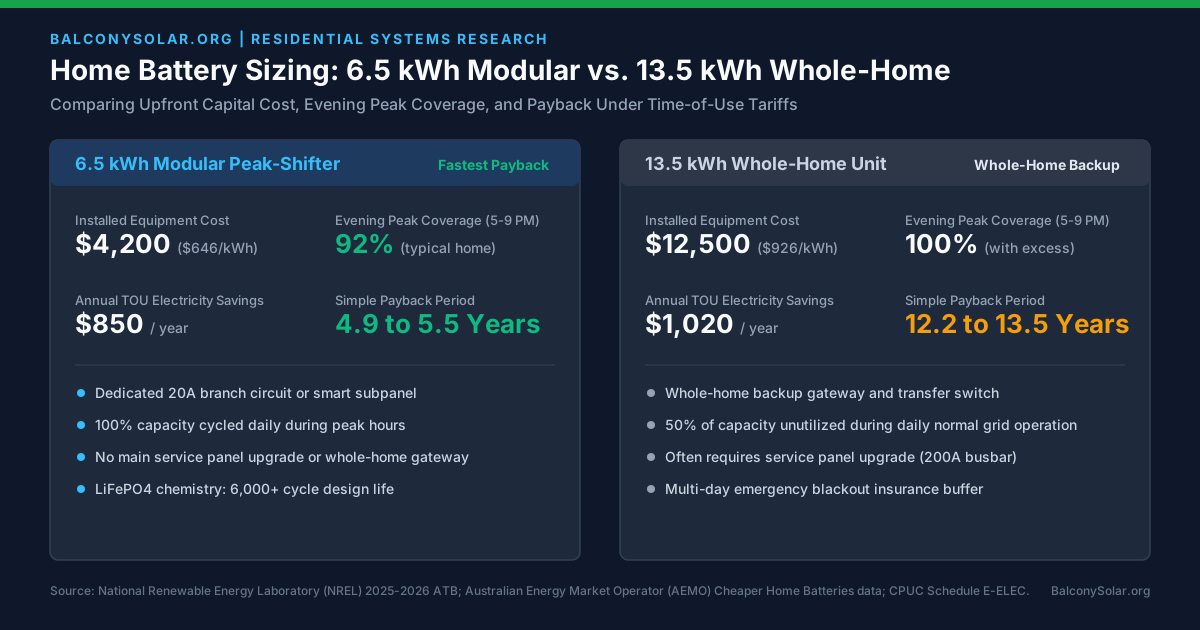
This guide examines household load physics, compares capital payback under US utility tariffs, and shows how to right-size battery storage for daily duck-curve peak shaving.
1. Household load math: why 6 to 7 kWh covers the evening peak
To size a battery accurately, you must separate energy capacity (measured in kilowatt-hours, kWh) from power output (measured in kilowatts, kW).
Energy capacity represents the size of the fuel tank. Power output determines how many appliances can run simultaneously.
According to the US Energy Information Administration (EIA Form EIA-861-M), the average American residential utility customer consumes roughly 899 kWh per month, or approximately 30 kWh per day.
However, that consumption is spread unevenly across the 24-hour cycle. The critical financial window under modern utility tariffs is the evening peak, typically running from 5:00 PM to 9:00 PM (or 4:00 PM to 9:00 PM in California).
During this 4-hour window, solar generation collapses while household activity rises.
Typical evening non-HVAC appliance loads
In an average apartment or single-family home without active central resistance heating, electricity demand during the 4-hour evening peak breaks down into standard categories:
- Continuous baseload (refrigerator, Wi-Fi router, ventilation, standby electronics): 300 W to 400 W continuous (1.2 to 1.6 kWh over 4 hours).
- Lighting and home entertainment (LEDs, televisions, monitors, laptops): 300 W to 500 W intermittent (1.0 to 1.5 kWh).
- Cooking and meal preparation (microwave, induction burner, exhaust fan): 1,200 W for 45 minutes to 1 hour (0.9 to 1.2 kWh).
- Domestic water circulation or partial appliance run: 500 W to 1,000 W for 1 hour (0.5 to 1.0 kWh).
Summing these real-world loads yields total evening consumption between 4.8 kWh and 6.5 kWh.
Even with a high-efficiency inverter heat pump or mini-split maintaining comfort, total evening consumption rarely exceeds 7.5 kWh in modern well-insulated homes.
Modeling from Australia’s Cheaper Home Batteries Program confirms this exact threshold: 6 kWh to 7 kWh of usable capacity satisfies the entire evening peak for over 90 percent of suburban homes.
2. The law of diminishing marginal returns in storage sizing
Why not purchase a 13.5 kWh battery anyway to be safe?
The answer lies in the economics of time-of-use rate arbitrageTime-of-Use Rate ArbitrageThe financial strategy of storing inexpensive energy (midday solar or cheap overnight grid power) and discharging it during high-rate peak hours to avoid expensive utility retail charges.EIA TOU Guide →.
Every battery cell you purchase incurs a capital amortization cost per cycled kilowatt-hour. To achieve a fast financial payback, every kilowatt-hour of installed battery capacity must work for you every single day.
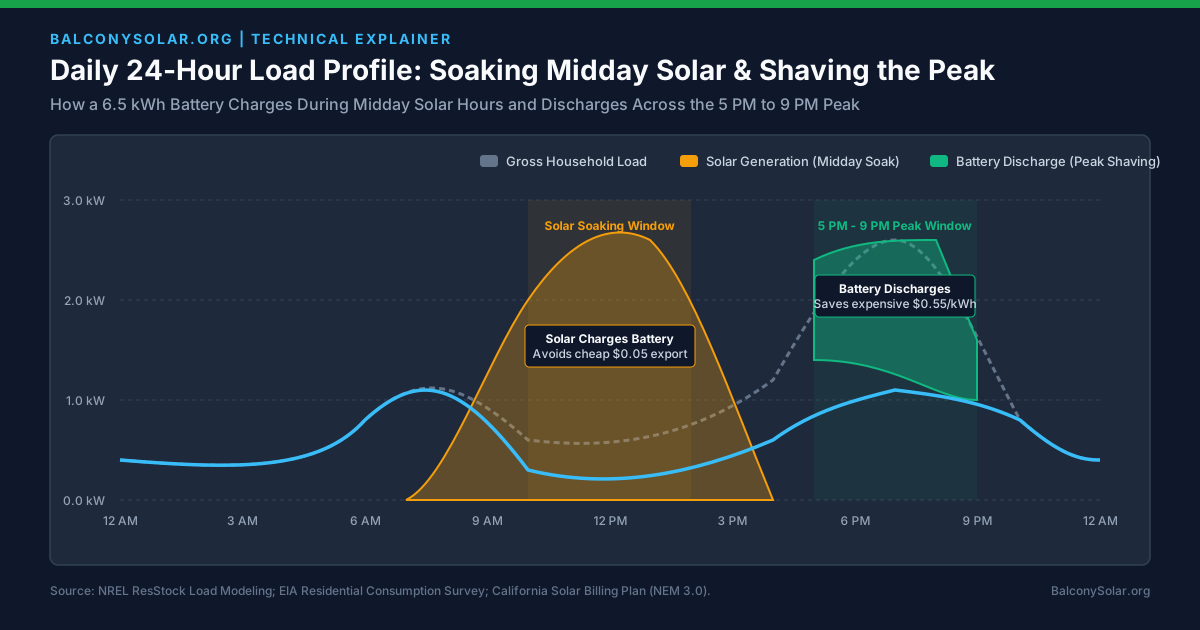
The high-value first tier (0 to 6.5 kWh)
The first 6.5 kWh of storage charges from excess midday solar generation or low off-peak grid power. It then discharges fully between 5:00 PM and 9:00 PM.
Under California’s Solar Billing Plan (NEM 3.0) or Time-of-Use rates (such as PG&E Schedule E-ELEC or SCE TOU-D-PRIME), peak electricity prices reach $0.50 to $0.65 per kWh.
Meanwhile, daytime export compensation drops to avoided-cost levels of roughly $0.05 per kWh.
By capturing 6 kWh of solar that would otherwise be exported for pennies and using it during the peak, you save roughly $3.00 every single day. Over a full year, that delivers approximately $850 to $1,000 in direct utility bill reductions.
The low-value second tier (6.5 to 13.5 kWh)
What happens to the remaining 7 kWh of a 13.5 kWh battery on an ordinary Tuesday?
Once 9:00 PM arrives, utility rates drop back to off-peak or partial-peak tiers (typically $0.25 to $0.32 per kWh).
If the second half of the battery discharges overnight, it only offsets off-peak grid power. The rate spread narrows from $0.50/kWh down to less than $0.15/kWh.
Worse, in many households without overnight EV charging, the extra 7 kWh cannot even discharge before sunrise. It simply sits full, suffering calendar fade without generating utility savings.
A 6.5 kWh battery operates at 95 to 100 percent daily active use. A 13.5 kWh unit often operates at only 50 percent daily active use during non-emergency periods.
3. Financial comparison: modular peak-shifter vs. whole-home backup
According to benchmark data from the National Renewable Energy Laboratory (NREL Annual Technology Baseline), the installed cost structures of these two approaches diverge significantly:
| Specification & Financial Metric | 6.5 kWh Modular Storage | 13.5 kWh Whole-Home Unit |
|---|---|---|
| Nominal Storage Capacity | 6.5 kWh | 13.5 kWh |
| Usable Capacity (90% DoD) | 5.85 kWh | 12.15 kWh |
| System Architecture | AC-coupledAC-Coupled BatteryA storage system that connects directly to the home AC electrical panel via a dedicated breaker, operating independently of the solar array inverter.DOE Storage Architecture → or DC plug-in | Hardwired gateway system |
| Hardware & Installation Ticket | $3,800 to $4,600 | $11,500 to $14,500 |
| Service Panel Upgrade Required? | Rarely (runs on 20A circuit) | Frequently (requires 200A busbar) |
| Automatic Transfer Switch / Gateway | Optional / critical circuits | Required for whole-home |
| Average Daily Peak Discharge | 5.5 kWh | 6.5 kWh (load-limited) |
| Annual Electricity Savings | $800 to $950 / year | $980 to $1,150 / year |
| Estimated Simple Payback Period | 4.8 to 5.6 Years | 11.5 to 13.8 Years |
As the matrix illustrates, spending three times as much capital for a 13.5 kWh system only delivers roughly 20 percent more annual bill savings.
Unless you place high personal value on whole-home emergency backup during prolonged blackouts, the modular 6 to 7 kWh format is mathematically superior for pure bill reduction.
You can simulate how different storage sizes interact with your specific balcony solar capacity using our solar production and savings simulator.
4. Hardware options: modular plug-in vs. subpanel storage
Modern storage options for evening peak shifting span two primary form factors:
Modular plug-in solar batteries
Designed specifically for balcony solar and apartment systems, plug-in battery units (such as Anker Solix Solarbank 2 Pro, EcoFlow PowerOcean, and Zendure SolarFlow) sit directly between your photovoltaic panels and your microinverter.
During sunny midday hours, panels charge the integrated lithium iron phosphate (LiFePO4) battery packs first.
Once evening arrives, a smart CT meter at your main switchboard tells the battery to discharge exactly what your home is consuming (e.g. 400 W to 800 W) back into your household circuit.
These units require zero rewiring, can be expanded in 1.6 kWh to 2.5 kWh increments up to 7 kWh, and unplug easily if you relocate.
Wall-mounted dedicated subpanel batteries
For single-family homes with dedicated electrical panels, modular wall-mounted units (such as Enphase IQ Battery 5P or Tesla Powerwall 3 configured with partial-home backup) connect to a standard 20 A or 30 A breaker.
Be sure your panelboard satisfies the NEC 705.12 120 percent busbar rule before adding backfeed breakers. You can check your electrical panel headroom instantly using our busbar backfeed calculator.
5. Virtual power plants: can grid incentives pay for your battery?
Beyond daily time-of-use rate arbitrage, home battery owners can tap a third revenue stream: participating in a virtual power plant (VPP)Virtual Power Plant (VPP)An aggregated network of distributed home batteries coordinated by software to supply grid capacity during peak demand emergencies.FERC VPP Primer →.
Under Federal Energy Regulatory Commission (FERC) Order 2222, regional grid operators must allow aggregated distributed energy resources to compete in wholesale capacity markets.
Active programs across leading states include:
- California Emergency Load Reduction Program (ELRP): Utilities like PG&E and SCE pay aggregators $1.00 to $2.00 per discharged kilowatt-hour during summer grid emergencies (10 to 30 events yearly). A 6 kWh discharge earns $6 to $12 per event.
- Rocky Mountain Power Wattsmart (Utah and Idaho): Offers upfront battery rebates between $400 and $600 per kilowatt plus ongoing monthly bill credits in exchange for regular grid dispatch rights.
- Texas ERCOT ADER Pilot: Aggregated distributed energy resources participate in ERCOT contingency reserve services, compensating battery owners who help stabilize the grid during heatwaves.
Virtual power plant sizing considerations
If you plan to join a VPP, keep two operational factors in mind:
First, reserve margins: Set a minimum backup reserve of 20 percent in your software. This prevents the utility from draining your battery before a storm-induced outage.
Second, cycle wear: Lithium iron phosphate chemistry handles 6,000 cycles to 70-80 percent retention, easily withstanding daily cycling plus 30 annual VPP events. For a detailed chemistry comparison between lithium and sodium storage, read our guide on Balcony Solar Battery Degradation: Lithium vs Sodium.
You can also project multi-decade battery retention curves under hot and moderate climates with our interactive degradation plotter.
6. How to size your battery in three steps
Follow this straightforward formula to calculate your ideal battery capacity:
- Check your electric bill interval data: Download your hourly smart meter data (Green Button data) from your utility account. Locate your average hourly kilowatt-hour draw between 5:00 PM and 9:00 PM during summer months.
- Apply the 4-hour peak formula: Multiply your average evening hourly demand by 4 hours. Divide that result by 0.90 to account for depth of discharge (DoD)Depth of Discharge (DoD)The percentage of battery capacity that can be safely discharged. Modern LiFePO4 batteries operate at 90 to 95 percent usable depth of discharge.NREL Battery Metrics → and round-trip efficiencyRound-Trip EfficiencyThe fraction of energy retrieved from a battery relative to the energy supplied during charging, typically 88 to 92 percent for LiFePO4 residential units.NREL Storage Analysis →.
- Compare with solar production: Ensure your balcony solar or rooftop array generates enough surplus midday electricity to recharge the unit. An 800 W balcony system produces 3.2 to 4.5 kWh of energy on a clear sunny day. If your array produces 4 kWh surplus, a 4.0 to 5.0 kWh battery matches your daily recharge capability perfectly.
For complete financial modeling on solar array sizing and equipment payback, visit our comprehensive Balcony Solar Sizing, ROI, and Payback Guide.
To learn how Australia proved this transition at national scale, read Australia Flattened Its Evening Peak With Batteries. To review which American regions lead storage adoption, see Taking the Evening Peak: Which US States Are Replicating Australia’s Battery Breakthrough?.
Sources
- US Energy Information Administration (EIA), Form EIA-861-M Monthly Electric Utility Sales and Revenue Report; Average Monthly Bill and Consumption by State.
- Australian Energy Market Operator (AEMO), Quarterly Energy Dynamics Q2 2026 report; Cheaper Home Batteries Program milestone data via DCCEEW.
- National Renewable Energy Laboratory (NREL), 2025-2026 Annual Technology Baseline (ATB): Residential Battery Storage Cost and Performance Assumptions.
- California Public Utilities Commission (CPUC), Decision D.22-12-056 (Net Energy Metering Revisit / Solar Billing Plan) and Avoided Cost Calculator (ACC).
- Pacific Gas and Electric Company, Electric Schedule E-ELEC (Residential Time-of-Use for Customers with Electric Heat Pumps and Storage).
- Federal Energy Regulatory Commission, Order No. 2222: Participation of Distributed Energy Resource Aggregations in Markets Operated by Regional Transmission Organizations.
- SunWiz and ABC News, Home Battery Rebate and Sizing Analysis: Sizing Home Batteries for Evening Peak Demand, May 2026.
Disclaimer: This article provides educational information on electrical storage sizing and utility rate structures. It does not constitute formal electrical design, tax, or investment advice. Always verify local electrical codes, utility interconnection rules, and circuit ampacity limits with a licensed electrician before installing storage equipment.