
Direct Answer (TL;DR)
Balcony solar batteries lose capacity through two mechanisms: active cycle aging (charge and discharge cycles) and passive calendar aging (driven by ambient heat and sustained high charge states). Unlike indoor whole-home storage, balcony batteries operate outdoors in unconditioned spaces exposed to summer heatwaves and sub-zero winter freezes.
LiFePO4 (LFP)LiFePO4 (Lithium Iron Phosphate)A lithium-ion chemistry utilizing iron phosphate cathodes, known for outstanding thermal stability, non-combustible properties, and 3,000 to 6,000 cycle durability. provides 3,000 to 6,000 cycles and high fire safety, but requires internal heating pads to charge below 0 °C (32 °F). NMC offers high energy density but only 1,000 to 2,000 cycles. Emerging Sodium-ion (Na-ion)Sodium-ion (Na-ion)A rechargeable battery technology utilizing abundant sodium ions instead of lithium, delivering exceptional sub-zero charging performance down to -20 °C without pre-heating. delivers 3,000 to 4,000 cycles, charges down to -20 °C without heaters, and completely eliminates thermal runaway risk.
Balcony solar kits pair naturally with compact battery storage. By capturing surplus midday solar electricity, a balcony battery feeds power back into your household circuits during the expensive evening peak.
Large residential batteries like the Tesla Powerwall or Enphase IQ sit inside temperature-controlled basements or garages. Balcony storage is different: it sits outside on open apartment terraces, private balconies, and fire escapes.
Outdoor placement exposes battery cells to intense summer sun, sub-zero winter freezes, and rain.
Understanding battery degradation physics helps you choose the right chemistry, protect your investment against premature failure, and maximize system lifespan.
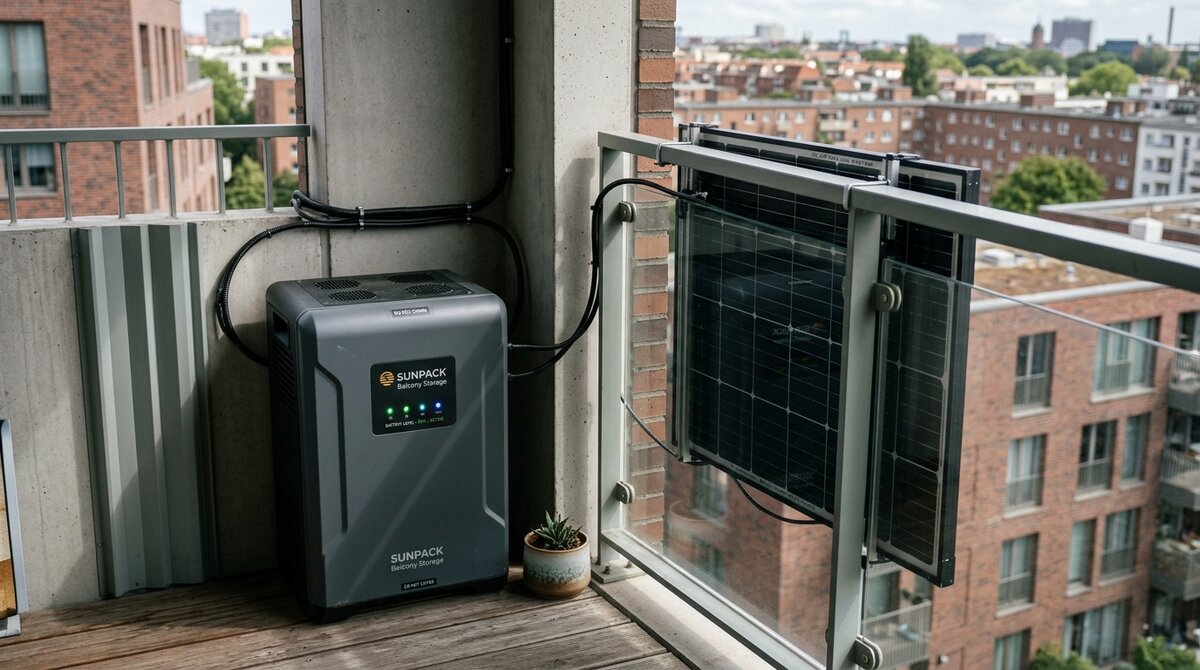 Outdoor balcony solar storage battery positioned in a shaded balcony corner.
Weather-resistant enclosures and smart thermal management protect cells from
accelerated calendar aging. Photo: BalconySolar.org.
Outdoor balcony solar storage battery positioned in a shaded balcony corner.
Weather-resistant enclosures and smart thermal management protect cells from
accelerated calendar aging. Photo: BalconySolar.org.
1. The two distinct ways balcony batteries degrade
All rechargeable batteries lose energy storage capacity over time. However, battery degradation does not depend solely on how often you charge and discharge the unit.
Two distinct chemical mechanisms degrade battery capacity:
Total Battery Degradation
 |
 |--[Cycle Aging]     -> Driven by charge/discharge throughput, C-rate, and Depth of Discharge (DoD)
 |
 \--[Calendar Aging]  -> Driven by time, storage temperature, and State of Charge (SoC)
1. Cycle aging (Mechanical and chemical wear during use)
Every time electricity flows into or out of a battery, lithium or sodium ions shuttle between the cathode and anode.
This ion transport triggers three physical degradation processes:
- SEI layer growthSEI (Solid Electrolyte Interphase)A passivation layer that forms on battery anodes during initial charging cycles, consuming active ions and slowly thickening over time to increase internal cell resistance.: A passivation film forms on graphite anodes during initial charge cycles. With each subsequent cycle, small micro-cracks expose fresh anode material, consuming active ions to repair the film and permanently reducing usable capacity.
- Electrode particle micro-cracking: Intercalation causes electrode materials to swell and contract physically (up to 10 percent volume change in lithium cells). Over thousands of cycles, mechanical stress fractures particles, isolating active material.
- Depth of Discharge (DoD) stress: Cycling a battery from 0 percent to 100 percent full capacity causes far greater mechanical expansion stress than cycling between 10 percent and 90 percent. Restricting discharge to 80 percent depth can double cycle life under NREL energy storage benchmarks.
2. Calendar aging (Degradation while resting)
A battery degrades even when disconnected on a shelf. This passive chemical degradation is called calendar aging.
Two primary environmental factors accelerate calendar aging:
- High ambient temperature: Chemical reaction rates roughly double for every 10 °C rise in operating temperature (Arrhenius relationship). A balcony battery sitting in 40 °C (104 °F) direct sunlight degrades more than twice as fast as a battery kept at 20 °C (68 °F).
- High State of Charge (SoC): Resting at 100 percent state of charge places severe electrochemical stress on cell cathodes and electrolytes. Storing a battery at 100 percent SoC in summer heat accelerates electrolyte oxidation and capacity fade.
+-----------------------+-----------------------------+-----------------------------+
| Operating Condition   | Impact on Cycle Aging       | Impact on Calendar Aging    |
+-----------------------+-----------------------------+-----------------------------+
| Ambient Heat (>35 °C) | Moderate (Higher impedance) | Severe (Doubles rate)       |
| Freezing Cold (<0 °C) | Critical (Lithium plating)  | Minimal (Slows reactions)   |
| High Charge (90-100%) | Moderate                    | High (Cathode stress)       |
| High Depth of Disch.  | High (Mechanical fatigue)   | Minimal                     |
+-----------------------+-----------------------------+-----------------------------+
2. The sub-zero charging hazard: Lithium plating
For balcony solar owners in cold climates, winter charging presents a serious physical hazard: lithium plating.
When an ordinary lithium-ion battery discharges in freezing temperatures, it functions normally, although cold electrolyte temporarily increases internal resistance and reduces available power.
However, charging a lithium battery below 0 °C (32 °F) causes irreversible damage:
- At sub-zero temperatures, lithium ions move sluggishly through cold electrolyte.
- When solar panels push charging current into the cell, lithium ions cannot intercalate quickly enough into graphite anode layers.
- Instead of entering the anode, lithium ions deposit onto the anode surface as metallic lithium film.
- This metallic plating permanently robs the battery of active lithium, causing immediate capacity loss.
- Over repeated sub-zero charges, sharp microscopic metallic spikes (dendrites) grow outward from the anode, potentially piercing the porous separator and causing an internal short circuit.
[Sub-Zero Solar Current: Charging Below 0 °C (32 °F)]
                          |
                          v
-----(Lithium Ions Sluggish in Cold Viscous Electrolyte)-----
                          |
                          v
=====[Anode Surface: Ions Cannot Intercalate Into Graphite]=====
                          |
                          +--> Permanent Metallic Lithium Plating
                          +--> Irreversible Usable Capacity Loss
                          +--> Dendrite Growth Piercing Separator
                          +--> Internal Short Circuit & Thermal Hazard
To prevent lithium plating, modern balcony batteries designed with LiFePO4 chemistry incorporate internal thermistors and electric heating pads. When winter morning sun activates the panels, the battery management system (BMS) diverts initial solar wattage to internal heating elements, warming the cells above 5 °C before allowing charging current to enter.
3. Chemistry face-off: LiFePO4 vs. NMC vs. Sodium-ion
Balcony solar storage systems employ three primary battery chemistries. Each presents distinct tradeoffs in cycle longevity, thermal resilience, and safety:
1. Lithium Iron Phosphate (LiFePO4 / LFP)
LiFePO4 represents the dominant chemistry in modern residential and balcony solar storage (used in systems like Anker SOLIX SolarBank, Zendure SolarFlow, and EcoFlow PowerStream).
- Cathode material: Lithium iron phosphate with a stable olivine crystal structure.
- Cycle life: 3,000 to 6,000 cycles to 80 percent original capacity (10 to 15 years of daily cycling).
- Thermal runaway threshold: Roughly 270 °C (518 °F). Because the chemical bond between phosphorus and oxygen is exceptionally strong, LFP cells do not release oxygen during thermal breakdown, making thermal runaway self-extinguishing.
- Operating temperature: Discharges safely from -20 °C to +55 °C (-4 °F to 131 °F). However, charging strictly requires temperatures above 0 °C (32 °F), necessitating internal heating pads in freezing climates.
- Verdict: The established, reliable standard for balcony solar storage today.
2. Nickel Manganese Cobalt (NMC / Traditional Li-ion)
NMC chemistry powered the first generation of electric vehicles and portable power stations.
- Cathode material: Layered lithium nickel manganese cobalt oxide.
- Cycle life: 1,000 to 2,000 cycles to 80 percent original capacity (3 to 6 years of daily cycling).
- Thermal runaway threshold: Lower threshold at roughly 150 °C to 200 °C (302 °F to 392 °F). Under internal short-circuit or physical puncture, decomposing NMC cathodes release oxygen, fueling vigorous and self-sustaining thermal runaway.
- Energy density: High gravimetric energy density (200 to 250 Wh/kg), making batteries compact and light.
- Verdict: Rapidly phased out for stationary balcony storage. The shorter cycle lifespan and higher fire hazard make NMC poorly suited for multi-family apartment balconies.
3. Sodium-ion (Na-ion / SIB, The emerging alternative)
Sodium-ion batteries replace lithium with abundant sodium ions derived from common soda ash and sea salt.
- Cathode and anode: Prussian white or layered transition metal oxides paired with a hard carbon anode.
- Cycle life: 3,000 to 4,000 cycles to 80 percent original capacity.
- Cold weather capability: Charges and discharges safely down to -20 °C (-4 °F) without internal heating pads. Sodium-ion batteries retain over 85 percent of their usable capacity at -20 °C, outperforming all lithium chemistries in freezing winter climates.
- Safety and zero-volt transport: Intrinsically non-flammable with higher thermal stability than LFP. Sodium-ion cells can discharge completely to 0.0 V for 100 percent safe transport and storage without cell degradation (unlike lithium cells, which degrade if discharged below 2.0 V).
- Raw material abundance: Sodium is over 500 times more abundant in the Earth’s crust than lithium. Sodium-ion cells use aluminum foil for both cathode and anode current collectors, eliminating expensive copper and scarce nickel or cobalt.
- Tradeoff: Slightly lower energy density (140 to 160 Wh/kg), making sodium-ion batteries roughly 15 to 20 percent heavier than LFP for identical capacity. For stationary balcony units resting on a floor, an extra 3 to 5 kg is practically inconsequential.
- Verdict: The ideal emerging chemistry for outdoor, unheated balcony solar installations in northern US and European climates.
+------------------------+--------------------+--------------------+--------------------+
| Feature                | LiFePO4 (LFP)      | NMC (Li-ion)       | Sodium-ion (Na+)   |
+------------------------+--------------------+--------------------+--------------------+
| Cycle Life (to 80%)    | 3,000 - 6,000      | 1,000 - 2,000      | 3,000 - 4,000      |
| Lifespan (Daily Use)   | 10 - 15 Years      | 3 - 6 Years        | 8 - 12 Years       |
| Thermal Runaway Temp   | ~270 °C (Very Safe)| ~150 - 200 °C      | Non-flammable      |
| Sub-Zero Charging      | No (Needs heater)  | No (Plating hazard)| Yes (-20 °C OK)    |
| Cold Capacity Ret.     | Moderate (~60%)    | Moderate (~70%)    | Outstanding (>85%) |
| Safe 0.0 V Discharge   | No (Cell damage)   | No (Cell damage)   | Yes (100% safe)    |
| Raw Material Bottleneck| Lithium supply     | Lithium, Cobalt, Ni| None (Sea salt)    |
| Energy Density         | 160 - 180 Wh/kg    | 200 - 250 Wh/kg    | 140 - 160 Wh/kg    |
| Balcony Suitability    | Excellent (Current)| Poor (Outdated)    | Superior (Emerging)|
+------------------------+--------------------+--------------------+--------------------+
4. How long will a balcony battery last in practice?
The practical lifespan of an outdoor balcony battery depends on daily cycle habits and climate management:
Sizing and daily throughput
A typical balcony solar kit produces between 2.5 kWh and 4.5 kWh of solar electricity daily.
Pairing an 800 W panel setup with a 1.6 kWh to 2.0 kWh battery allows you to store daytime surplus and discharge it during evening peak utility hours. This pattern results in one full cycle per day (365 cycles per year).
- At 3,500 cycles to 80 percent capacity, a quality LiFePO4 or Sodium-ion battery will deliver roughly 10 years of continuous daily operation before dropping to 80 percent of its initial storage capacity.
- Even at 80 percent capacity, the battery remains functional, storing 1.3 kWh instead of 1.6 kWh.
Solar modules degrade at 0.4 percent annually across a 30-year design lifespan, proven in our solar panel degradation rate guide and the historical Arco Solar desert study. To model battery retention curves over 15 years and compare LiFePO4, Sodium-ion, and NMC degradation under different climate conditions, use our interactive Solar & Battery Degradation Trajectory Plotter.
Expect one or two battery replacements during thirty years of solar generation.
Shifting the evening peak
Battery storage transforms balcony solar economics by storing cheap daytime kilowatt-hours to displace peak evening grid rates.
See our analysis on how residential batteries flattened the evening peak in Australia and explore the underlying physics in our duck curve and load shifting explainer.
5. Five rules to maximize balcony battery lifespan
To protect your battery against accelerated calendar and cycle aging, implement these practical installation rules:
- Keep the battery in deep shade: Never place your battery where direct afternoon sunlight strikes the metal casing. Place the unit in a shaded corner behind balcony masonry or under a ventilated protective canopy.
- Elevate off hot concrete: Balcony concrete slabs absorb solar heat and reach temperatures over 50 °C (122 °F) in summer. Use heavy-duty rubber equipment feet to create a 5 cm air gap beneath the battery.
- Limit summer charging to 90 percent: During prolonged summer heatwaves, configure your battery management app to stop charging at 90 percent state of charge. Avoiding sustained 100 percent saturation at high ambient temperatures cuts calendar degradation in half.
- Verify winter heating before buying LFP: If you live in a climate where winter temperatures drop below freezing, confirm that your LiFePO4 battery includes automatic pre-heating pads. If it lacks heating, bring the battery indoors during winter months.
- Consider Sodium-ion for cold outdoor balconies: In northern states without indoor winter storage space, consider emerging plug-in sodium-ion batteries. These units charge reliably down to -20 °C without parasitic heating loss.
Model your potential bill savings and storage payback with our interactive Household Sizing Simulator.
References and primary sources
- Preger, Y., et al. (2020). Degradation of Commercial Lithium-Ion Cells as a Function of Chemistry and Cycling Conditions. Journal of The Electrochemical Society, 167(12), 120532 (DOI: 10.1149/1945-7111/abae37).
- National Renewable Energy Laboratory. Battery Lifetime Analysis and Simulation Tool (BLAST). NREL Energy Storage Research (nrel.gov/transportation/blast.html).
- Underwriters Laboratories. ANSI/CAN/UL 9540: Standard for Energy Storage Systems and Equipment.
- Chayambuka, K., et al. (2020). From Validated Sodium-Ion Battery Models to Realistic Energy Storage Applications. Electrochimica Acta, 362, 137088 (DOI: 10.1016/j.electacta.2020.137088).