
Direct Answer (TL;DR)
Balcony solar systems should be sized primarily to match continuous household baseload and daytime self-consumption habits. Enacted state statutes (including Utah, New Jersey, Virginia, Vermont, and Connecticut) either explicitly exempt plug-in devices from retail net metering or state that exported power is uncompensated. For most apartments, a single 400 W panel (offsetting 150 W to 300 W background loads) yields the fastest payback of 3 to 4 years. An 800 W dual-panel setup requires intentional daytime appliance shifting to avoid uncredited grid backfeed.
When shopping for balcony solar, newcomers are frequently advised to calculate what their apartment draws at 1:00 PM and avoid buying any more panel capacity than their instantaneous daytime consumption.
In the United States, that advice is essential because plug-in solar devices are generally excluded or exempt from retail net metering programs.
Unlike utility-scale or traditional rooftop solar installations that undergo formal utility interconnection studies and bilateral net-metering contracts, plug-in balcony solar relies on statutory exemptions to operate legally without costly utility engineering reviews. As a direct consequence, enacted state laws (such as in Utah, Vermont, Connecticut, New Jersey, and Virginia) do not require utilities to provide retail net metering credits for power exported through a standard wall outlet. In Vermont, exported electricity is explicitly uncompensated; in Connecticut, uncredited backfeed on unprogrammed meters can even be billed as usage.
This guide explains how to size your balcony solar setup based on your budget, mounting space, direct self-consumption, and statutory metering constraints to calculate an honest return on investment (ROI).
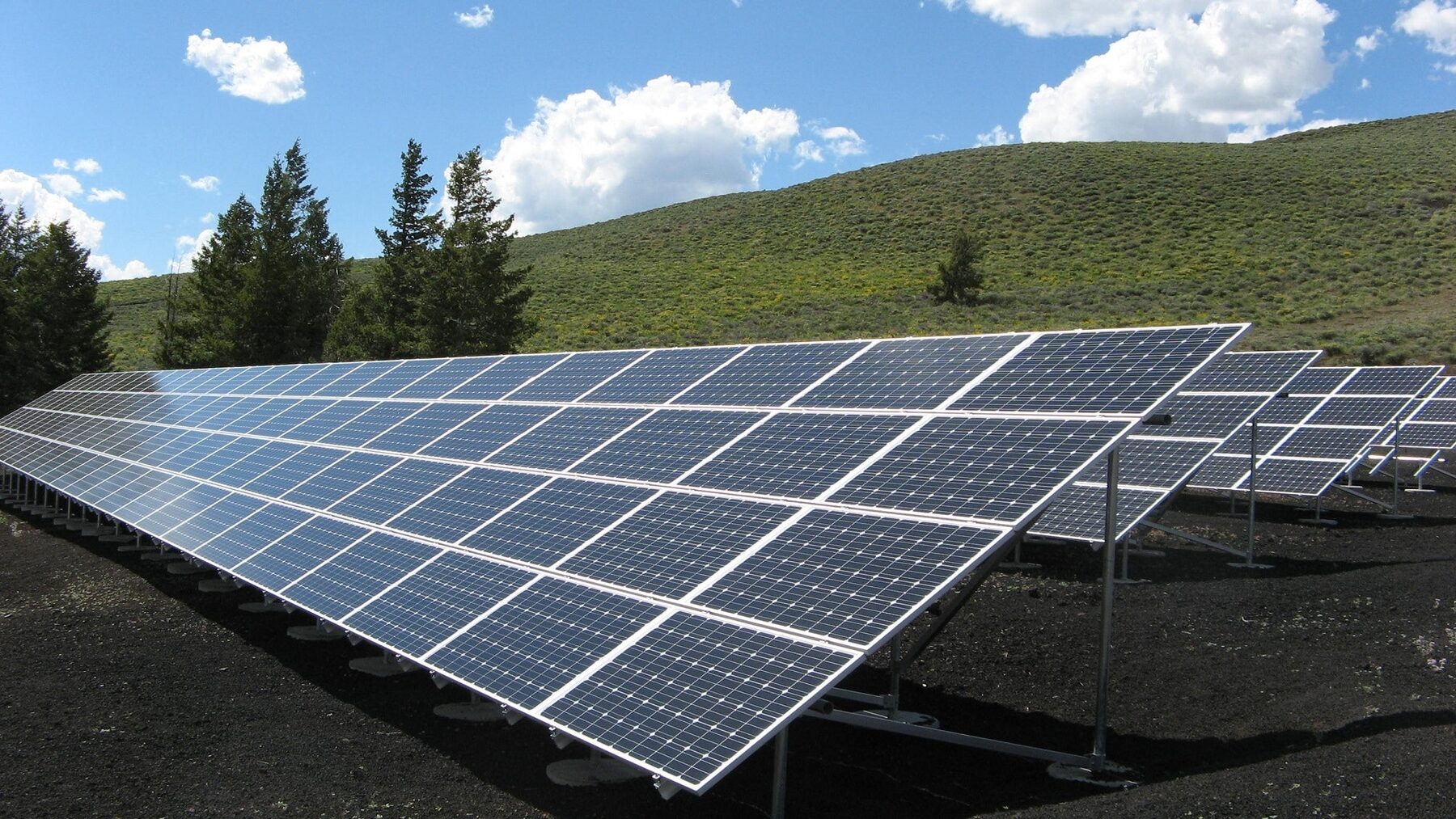 Monocrystalline photovoltaic solar panels. Modern high-efficiency panels generate
400 W to 450 W per module, maximizing output on limited balcony space. Photo:
Wikimedia Commons (CC0).
Monocrystalline photovoltaic solar panels. Modern high-efficiency panels generate
400 W to 450 W per module, maximizing output on limited balcony space. Photo:
Wikimedia Commons (CC0).
1. Sizing Drivers: Statutory Metering Rules and Baseload
The decision between a single-panel (approx. 400 W) or dual-panel (approx. 800 W) kit depends on two interrelated factors:
A. Statutory Net Metering Exclusions and Grid Backfeed
Many homeowners assume that solar panels automatically spin electric meters backward under 1-to-1 retail net metering. For plug-in balcony solar, this assumption is incorrect under enacted state statutes:
- Statutory Net Metering Exemptions: Statutes in Utah (Utah Code 54-15-601), New Jersey (P.L.2026, c.82), and Virginia (SB 250 / Chapter 998) exempt plug-in solar devices from utility interconnection agreements and fees. These laws simultaneously exempt them from formal net-metering program requirements. Utilities are not mandated to provide retail billing credits for exported surplus.
- Uncompensated Export Regimes: Under Vermont law (Act 149 / S.202), exported power from plug-in photovoltaic devices is uncompensated. Customers with existing rooftop net-metering contracts cannot connect a plug-in unit.
- Meter Misregistration and Warnings: In Connecticut (Public Act 26-127, Section 9), the statute mandates a specific warning on devices. The label warns that excess generation is charged as consumption unless the meter allows net metering. Older electromechanical or unidirectionally programmed digital meters record backfed current as power drawn from the grid.
Because export credits cannot be legally assumed, sizing a balcony solar system must prioritize self-consuming 100% of generated power on-site (modeled via NREL load profiles).
B. Household Base Load and Direct Self-Consumption
A standard 400-watt balcony panel mounted at vertical railing angles produces between 1.2 and 2.0 kilowatt-hours per day in typical US latitudes. A dual-panel 800-watt system produces 2.4 to 4.0 kWh per day.
Typical American households maintain a constant background “idle load” of 150 to 300 watts from refrigerators, Wi-Fi routers, entertainment devices on standby, ventilation, and electronics.
- According to NREL residential load profiles, a 400 W system has 70% to 90% of its generation absorbed directly by background idle loads without changing household habits.
- An 800 W system produces midday surges that exceed typical idle loads. Without battery storage, you will export excess midday energy unless you actively schedule daytime loads (running a dishwasher, laundry, or work-from-home computing) during peak sun hours (10:00 AM to 2:00 PM).
2. The Two Core Balcony Solar System Tiers
Physical railing dimensions, standard 120V outlet ratings, and equipment packaging naturally group balcony solar into two practical tiers:
+-----------------------+---------------------+--------------------+--------------------+
| System Tier           | Equipment Rating    | Typical Cost (USD) | Annual Generation  |
+-----------------------+---------------------+--------------------+--------------------+
| Tier 1: Single-Panel  | 350W - 450W Panel   | $350 - $500        | 400 - 650 kWh/year |
| Starter Kit           | 400W Microinverter  |                    |                    |
+-----------------------+---------------------+--------------------+--------------------+
| Tier 2: Dual-Panel    | 700W - 900W Panels  | $700 - $1,000      | 800 - 1,300 kWh/yr |
| Standard Kit          | 800W Microinverter  |                    |                    |
+-----------------------+---------------------+--------------------+--------------------+
Tier 1: Single-Panel Starter (350 W–450 W)
- Best for: Small balconies, railings under 7 feet wide, studio or 1-bedroom apartments, or cautious first-time buyers on a budget under $500.
- Physical Footprint: Approximately 5.7 feet by 3.7 feet (1.7 m x 1.1 m). Weighs about 40 to 48 pounds.
- Electrical Connection: Plugs directly into an outdoor NEMA 5-15NEMA 5-15 ReceptacleThe standard three-prong 120-volt, 15-ampere grounded electrical outlet found across residential buildings in the United States.Outdoor Outlet Safety Guide → receptacle via a dedicated 400 W microinverterMicroinverterA compact inverter attached to an individual solar panel that converts direct current (DC) to household alternating current (AC) at module level.Energy.gov Inverter Overview →.
- Annual Yield: Generates roughly 400 to 650 kWh annually depending on latitude, tilt, and shading.
Tier 2: Dual-Panel Standard (700 W–900 W)
- Best for: Balconies with at least 13 feet of unobstructed railing, 2+ bedroom homes, or users aiming to maximize bill savings.
- Physical Footprint: Two panels side-by-side (approx. 13 feet total width) or corner-mounted.
- Electrical Connection: Dual-input microinverter with dual MPPTMaximum Power Point Tracking (MPPT)Real-time circuit optimization that dynamically adjusts electrical voltage and current to maximize panel wattage under varying sunlight.MPPT Guide → channels feeding into a single 800-watt AC plug. The inverter injects up to 6.67 amperes at 120V onto the branch circuit. Under NEC 705.12 principles, connecting generation to a branch circuit requires confirming that the circuit is in good condition, protected by GFCI, and not shared with heavy continuous loads.
- Annual Yield: Generates roughly 800 to 1,300 kWh annually.
3. Calculating Realistic ROI and Payback Period
Hardware represents the vast majority of your initial investment because balcony systems avoid roof installation labor, cranes, and structural engineering fees.
To calculate your payback period accurately, model self-consumption and export compensation separately:
Annual Dollar Savings = (Self-Consumed kWh x Avoided Retail Rate) + (Exported kWh x Export Credit Rate) - Incremental Annual Costs
Simple Payback (Years) = Total System Cost ($) / Annual Dollar Savings ($/year)
Realistic and Hypothetical Payback Scenarios
Consider a standard dual-panel system costing $800 all-in and generating 1,000 kWh/year, modeled using typical yields from NREL PVWatts at a retail electricity rate of $0.25/kWh:
-
Scenario 1: Realistic Statutory Baseline - Uncompensated Export (50%
self-consumption)
(NREL PVWatts):
- Applicable to standard plug-in installations where exported energy receives zero credit (e.g., Vermont Act 149, Utah Code 54-15-601).
- 500 kWh self-consumed: 500 kWh x $0.25 = $125
- 500 kWh exported: 500 kWh x $0.00 = $0
- Annual Savings: $125/year
- Simple Payback: $800 / $125 = 6.40 years
-
Scenario 2: Optimized Self-Consumption - Daytime Load Shifting (80%
self-consumption)
(Household Simulator):
- Achieved by timing washing machines, dishwashers, and daytime electronics to run between 10:00 AM and 2:00 PM.
- 800 kWh self-consumed: 800 kWh x $0.25 = $200
- 200 kWh exported: 200 kWh x $0.00 = $0
- Annual Savings: $200/year
- Simple Payback: $800 / $200 = 4.00 years
-
Scenario 3: Single-Panel Matched Baseload ($400 cost, 500 kWh/year, 90%
self-consumption)
(Household Simulator):
- Sizing down to a 400 W kit that matches constant background apartment idle load.
- 450 kWh self-consumed: 450 kWh x $0.25 = $112.50
- 50 kWh exported: 50 kWh x $0.00 = $0
- Annual Savings: $112.50/year
- Simple Payback: $400 / $112.50 = 3.56 years
-
Scenario 4: Hypothetical Rooftop-Style Retail Net Metering (Illustrative Model
Only)
(DSIRE Database):
- (Caution: Purely hypothetical scenario. Plug-in solar devices have zero statutory entitlement to retail net metering under enacted state laws; this scenario illustrates traditional rooftop NEM for comparison only).
- 100% of production offsets retail energy: 1,000 kWh x $0.25 = $250/year
- Simple Payback: $800 / $250 = 3.20 years
-
Scenario 5: Hypothetical Avoided-Cost Net Billing (Illustrative Model
Only)
(OpenEI Utility Rates):
- (Caution: Purely hypothetical scenario assuming voluntary utility export compensation of $0.06/kWh, which is not guaranteed by statute for plug-in systems).
- 500 kWh self-consumed: 500 kWh x $0.25 = $125
- 500 kWh exported: 500 kWh x $0.06 = $30
- Annual Savings: $125 + $30 = $155/year
- Simple Payback: $800 / $155 = 5.16 years
Modern monocrystalline panels carry warranties of 20 to 25 years guaranteeing at least 80 percent of initial output, while microinverters carry warranties of 10 to 12 years. For a detailed analysis of multi-year output drop, cell types, and hot-climate longevity, see our guide on Solar Panel Degradation Rate Expectations. Sizing to your continuous baseload achieves capital payback within 3.5 to 4 years, delivering decades of free electricity without relying on uncertain utility export compensation.
4. How State Legislation and Metering Policies Shape Sizing
Before finalizing your equipment purchase, consider how statutory rules govern your installation:
A. Statutory Baseload Matching (The Safest Path)
Because enacted state laws exempt utilities from net-metering obligations for plug-in solar, the safest financial strategy is baseload matching:
- Sizing Strategy: Size your array to match your apartment’s continuous standby load (typically 200 W to 400 W). A single 400 W panel will rarely export power, ensuring that virtually every watt generated offsets retail electricity consumption.
B. Daytime Energy Shifting (For 800 W Dual-Panel Systems)
If you have ample railing space (13+ feet) and want an 800 W dual-panel setup:
- Sizing Strategy: Use smart plugs, appliance timers, or home automation to run energy-intensive tasks (laundry, dishwashing, water heating, EV trickle charging, or portable power station charging) during peak sun hours. This keeps self-consumption above 75% to 80% (modeled via NREL residential load profiles), avoiding uncredited grid export.
C. Meter Checks and Utility Warnings
Inspect your home’s electric meter before connecting equipment:
- Bidirectional Smart Meters: Smart meters programmed for bidirectional flow will measure power drawn from the grid and ignore or register uncompensated export without penalty.
- Unidirectional or Detented Meters: Older mechanical or digital meters measure reverse current as consumption, billing homeowners for exported energy. In Connecticut (PA 26-127), devices must carry a statutory warning regarding this risk. If you have an older meter, consult your utility or ensure your microinverter has zero-export limiters enabled.
5. Physical and Safety Constraints Checklist
Before ordering hardware, confirm that your setup satisfies these core physical and electrical safety boundaries:
- Railing Weight and Wind Load: A 400 W panel weighs roughly 42 lbs (19 kg). Ensure your railing is structurally sound, made of solid metal or reinforced masonry, and uses certified non-penetrating outdoor brackets.
- Dedicated or Lightly Loaded Circuit: Connect the microinverter to a standard 120V outdoor outlet that does not already power high-draw continuous appliances (such as space heaters or large air conditioners).
- Certified Anti-Islanding: Ensure your inverter carries an authentic anti-islandingAnti-Islanding ProtectionAn automated safety mechanism that shuts down power output within 2.0 seconds when grid power fails.Anti-Islanding Safety Guide → listing under UL 1741 or UL 1741-SB to ensure rapid disconnection during power outages.
- Orientation and Shading: A south-facing railing receives peak solar irradiance. East- and west-facing railings still produce 70% to 85% of rated output, while heavily shaded or north-facing balconies will see reduced annual yield.
Sizing Decision Summary
Use this straightforward 3-step rule to choose your system:
- Check Your Daytime Baseload: For a home with modest idle draw (150 W to 250 W) and no daytime occupants, choose a 400 W single-panel starter kit ($350-$500). This provides rapid 3.5-year payback without grid export. If you work from home or can shift appliances to midday hours, an 800 W dual-panel system ($700-$1,000) maximizes total electricity offset.
- Check Your Railing Space: If you have 6 feet of railing, choose 1 panel; if you have 13+ feet, choose 2 panels.
- Verify State Rules: Plug-in systems do not receive retail net metering under enacted statutes. Review your jurisdiction’s specific statutory requirements in the legal inclusion below.
Before ordering, check the balcony solar rules for your state and confirm the utility requirements for your address.
Statutory and Regulatory Requirements
Connecticut (CT) - Status: future-effective (effective 2026-10-01)
Notice: This statute is future-effective and does not represent current active requirements.
Maximum Power Capacity: no verified capacity limit
Net Metering Treatment: unverified - Net metering treatment unverified or standard.
Utility Interconnection: unverified - Interconnection unverified
New Jersey (NJ) - Status: future-effective (effective 2027-03-01)
Notice: This statute is future-effective and does not represent current active requirements.
Maximum Power Capacity: no verified capacity limit
Net Metering Treatment: unverified - Net metering treatment unverified or standard.
Utility Interconnection: unverified - Interconnection unverified
Utah (UT) - Status: effective
Maximum Power Capacity: 1200 W
Net Metering Treatment: exempt - Exempt from net metering program requirements.
Utility Interconnection: exempt - Statutory exemption from interconnection approval.
Virginia (VA) - Status: future-effective (effective 2027-01-01)
Notice: This statute is future-effective and does not represent current active requirements.
Maximum Power Capacity: no verified capacity limit
Net Metering Treatment: unverified - Net metering treatment unverified or standard.
Utility Interconnection: unverified - Interconnection unverified
Vermont (VT) - Status: effective
Maximum Power Capacity: 1200 W
Net Metering Treatment: uncompensated_export - Net metering treatment unverified or standard.
Utility Interconnection: exempt - Statutory exemption from interconnection approval.