
Direct Answer (TL;DR)
A 30-year field study of 1980-era Arco Solar monocrystalline modules in the Algerian Sahara found panels still deliver an average of 53 percent of their rated power. The modules experienced an annual degradation rate between 1.0 percent and 2.0 percent under extreme desert heat, high UV radiation, and abrasive sand.
While visual inspection showed complete EVA encapsulantEVA (Ethylene Vinyl Acetate)A polymer laminating sheet used to seal photovoltaic cells between glass and backsheets, prone to browning under early formulations lacking UV stabilizers. browning and 37 percent failed wet insulation tests, the silicon cells remained operational. Modern balcony solar panels use dual-glass construction, polyolefin encapsulants, and multi-busbar designs that eliminate these historic failure modes.
How long do solar panels really last when pushed to their environmental limits?
Most modern solar manufacturers offer 25-year to 30-year performance warranties. Yet skeptical homeowners and renters considering balcony solar often wonder if those warranties reflect lab optimism rather than outdoor reality.
A landmark field study published in the journal Next Energy answers that question with empirical data. Researchers evaluated 64 vintage Arco Solar modules operating across three decades in one of the most punishing climates on Earth: the Algerian Sahara.
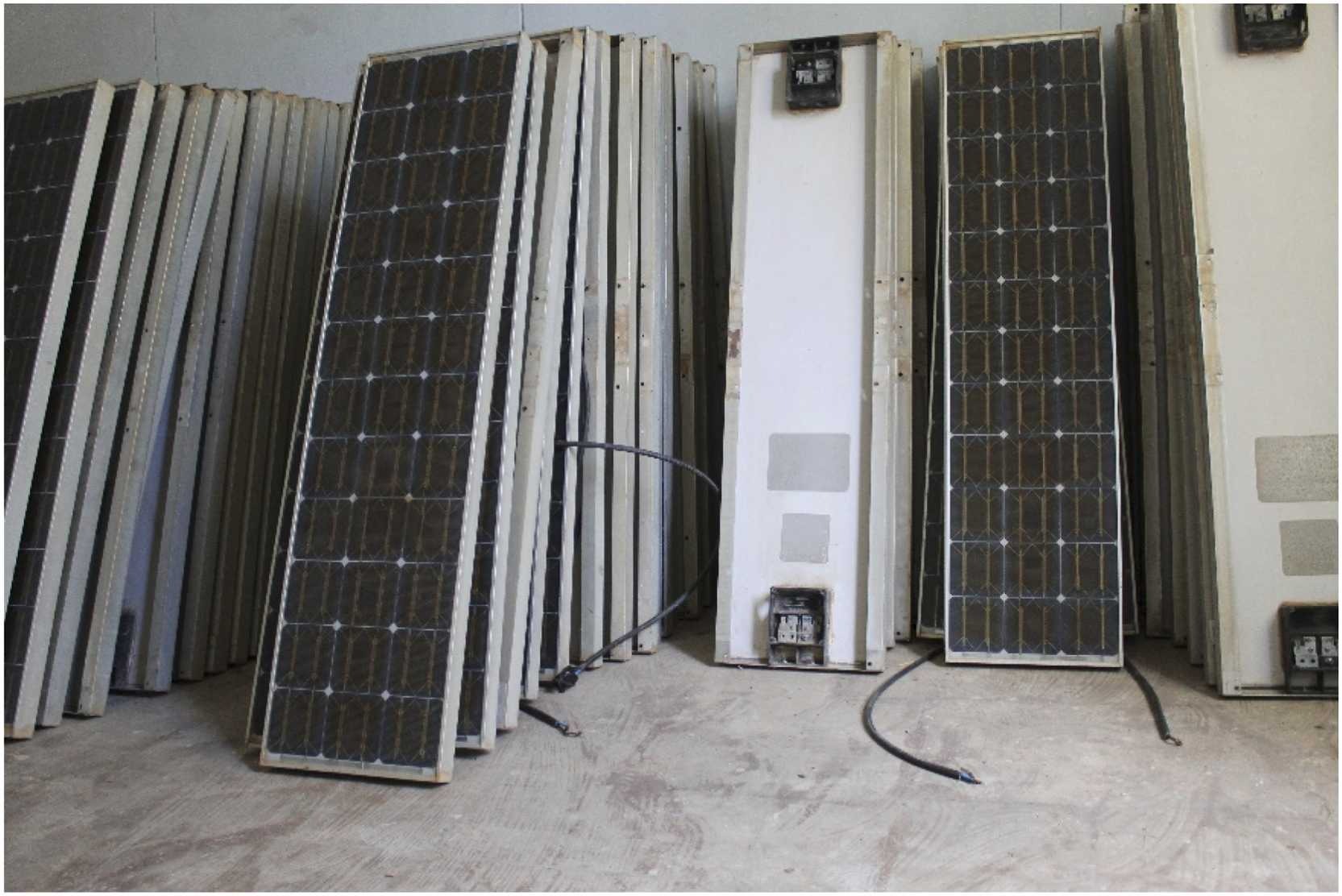
A stack of vintage 1980-era Arco Solar monocrystalline photovoltaic modules retrieved after 30 years of field operation for testing at CDER in Algiers. Photo: Hafdaoui et al., Next Energy (2026), DOI: 10.1016/j.nxener.2026.101009 (CC BY 4.0).
The findings demonstrate both the remarkable resilience of crystalline silicon and the specific material weaknesses that modern manufacturing has overcome.
1. The 30-year test environment
The study was conducted by lead author Hichem Hafdaoui and colleagues at the Centre de Developpement des Energies Renouvelables (CDER) in Algiers, documented in their Next Energy research report. The researchers examined 64 monocrystalline silicon modules manufactured in the 1980-era by Arco Solar.
Each module carries 36 monocrystalline silicon cells with a nominal nameplate rating of 43 W under Standard Test Conditions (STC: 1000 W/m², AM 1.5, 25 °C).
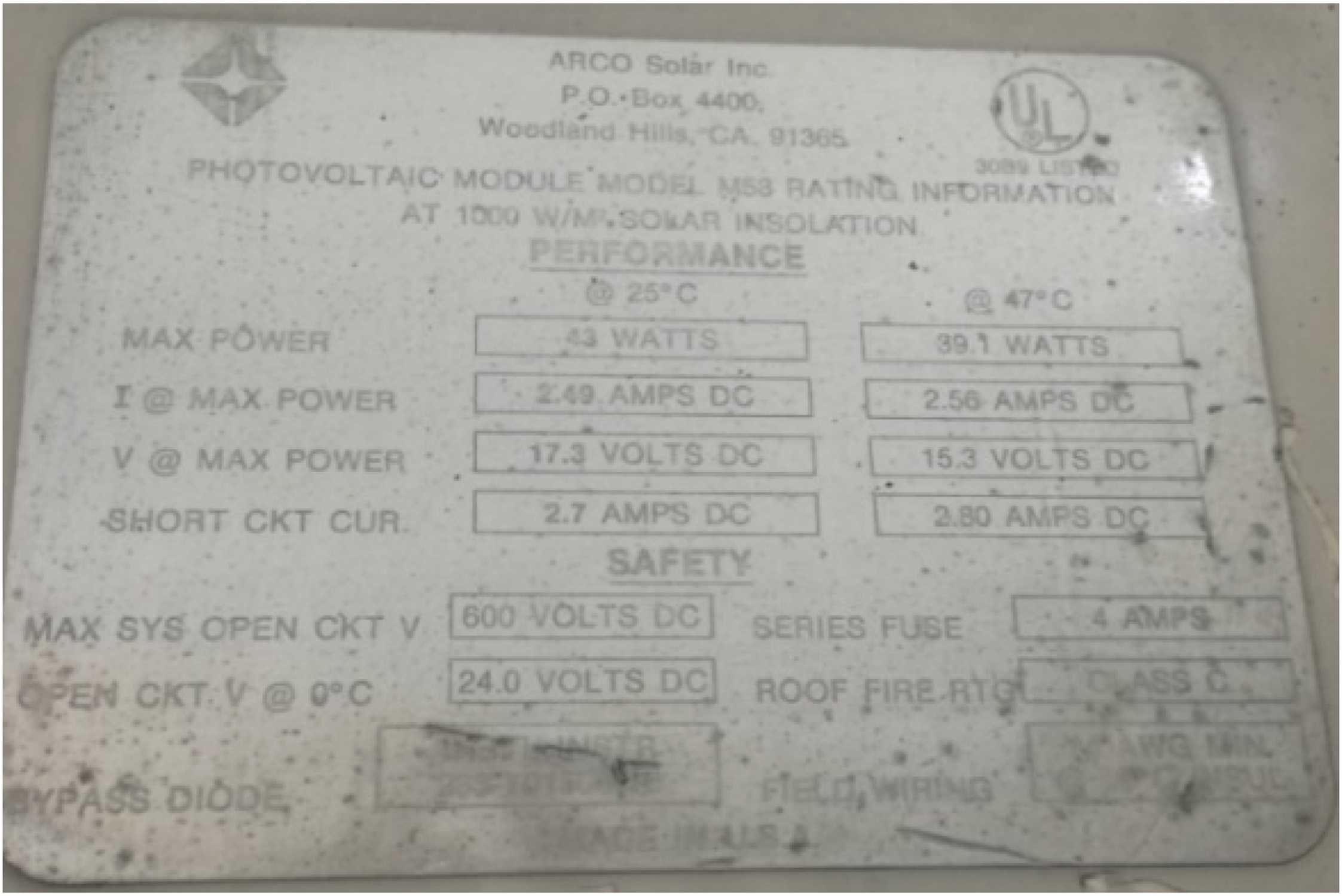
Original manufacturer rating nameplate on the rear of a tested Arco Solar module, documenting standard test condition ratings before three decades of environmental exposure. Photo: Hafdaoui et al., Next Energy (2026), DOI: 10.1016/j.nxener.2026.101009 (CC BY 4.0).
These panels endured three distinct operating phases over 30 years:
- 20 years in Adrar, Sahara Desert: Installed in an off-grid solar-plus-battery pumping and lighting station in southwestern Algeria. This region experiences ambient summer temperatures exceeding 45 °C (113 °F), intense ultraviolet exposure, wide diurnal temperature swings, and severe sandstorms.
- 5 years in Bouzareah, Algiers: Relocated to CDER headquarters in a coastal Mediterranean climate, integrated into a hybrid solar-wind system.
- 5 years outdoors in Algiers: Stored outdoors in an unmanaged state at open-circuit voltage (VocOpen-Circuit Voltage (Voc)The maximum voltage available from a solar module when no external current is flowing through a connected electrical load.).
This 30-year sequence exposed the hardware to extreme heat, thermal cycling, moisture, coastal salt air, and mechanical abrasion from wind-blown sand.
2. Power retention: 53 percent average output
The headline finding of the CDER study is that after 30 years of unmanaged exposure, the modules generated an average maximum power (PmaxMaximum Power (Pmax)The highest power operating point on a photovoltaic module current-voltage curve under standard test conditions.) of 22.77 W, as recorded in the CDER study publication.
That represents 53 percent of original rated capacity.
Across the 64 tested panels, individual performance varied:
- Best-performing module: Delivered 29.75 W (69.2 percent of original nameplate).
- Lowest-performing module: Delivered 15.91 W (37.0 percent of original nameplate).
- Average annual degradation rate: Ranged from 1.0 percent to 2.0 percent per year, with a cohort mean of roughly 1.55 percent per year.
For modules engineered in the dawn of commercial photovoltaics, retaining more than half their generating power after 30 years of desert heat is an impressive benchmark.
To understand how this compares with modern production expectations, explore our comprehensive guide on solar panel degradation rate expectations.
[1984 Brand New Arco Solar Module: 43.0 W Rated Nameplate (100%)]
                              |
     20 Years Sahara Desert   | (Heat, sand abrasion, UV)
     5 Years Mediterranean    | (Humidity, coastal salt)
     5 Years Open-Circuit     | (Passive outdoor thermal swings)
                              v
[2024 Measured Cohort Average: 22.8 W Retained Power (53%)]
     - Highest Retained:  29.8 W (69.2%)
     - Lowest Retained:   15.9 W (37.0%)
     - Effective Loss:    1.0% to 2.0% per year
3. What failed: Failure modes under IEC 61215
The researchers subjected the 64 panels to visual and electrical stress testing under the international standard IEC 61215IEC 61215The core international design qualification and type approval standard testing terrestrial crystalline silicon photovoltaic modules for long-term outdoor operation., cross-referenced against NREL photovoltaic degradation standards.
Four specific failure mechanisms caused the power drop:
EVA browning and busbar discoloration (100 percent of panels)
Every single panel in the test cohort exhibited severe yellowing and browning of the ethylene vinyl acetate (EVA) encapsulant, as documented in the CDER study report.
Early EVA formulations from the 1980-era lacked modern ultraviolet stabilizers. Under intense desert UV radiation and elevated cell temperatures, the polymer degraded and formed polyene chromophores. This browning acts like tinted sunglasses over the solar cells, blocking light transmission and directly reducing short-circuit current (IscShort-Circuit Current (Isc)The maximum electrical current generated by a solar module when its positive and negative output terminals are shorted together.).
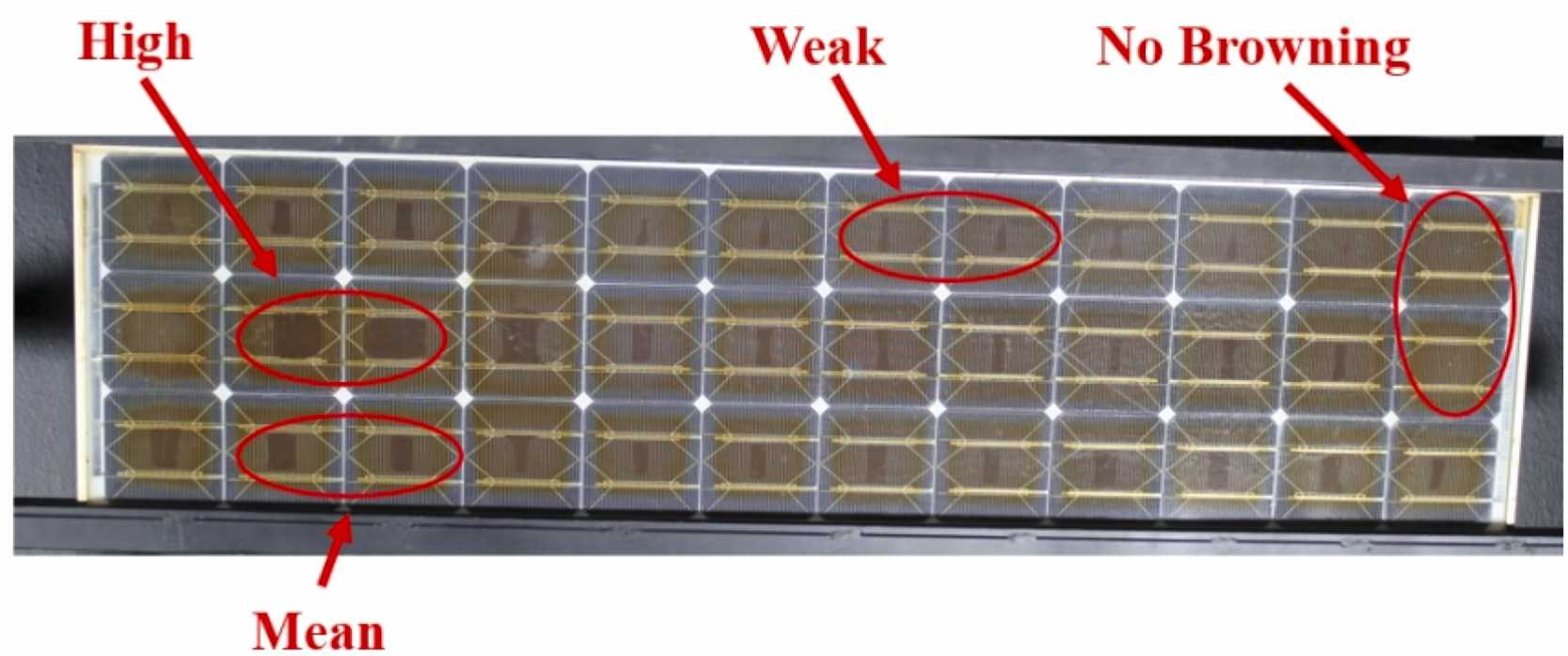
Severe EVA encapsulant browning and busbar discoloration observed across tested Arco Solar cells after prolonged desert UV exposure and thermal cycling. Photo: Hafdaoui et al., Next Energy (2026), DOI: 10.1016/j.nxener.2026.101009 (CC BY 4.0).
Hot spots and localized shunting (46 percent of panels)
Infrared thermography revealed hot spots in nearly half of the modules under NREL testing guidelines.
Diurnal temperature shifts in the Sahara cause solder joints connecting solar cells to expand and contract repeatedly. Over 20 years, solder fatigue created open micro-cracks. When current flows through fractured cell contacts, localized electrical resistance spikes, dissipating energy as intense heat rather than electricity.
Detached junction boxes and frame separation
Thermal expansion differences between the glass, aluminum frames, and polymer backsheets degraded original bonding adhesives. Several junction boxes loosened or separated from panel backs, exposing electrical connections.
Wet insulation leakage (37 percent failed)
The most critical safety finding involved electrical isolation resistance under IEEE electrical safety benchmarks:
- Dry insulation test: 100 percent of the modules passed, showing insulation resistance above 400 MΩ.
- Wet leakage test: 37 percent failed, measuring below the IEC 61215 safety threshold of 40 MΩ·m².
Moisture had penetrated through micro-fissures in aged polymer backsheets and deteriorated edge seals. While dry panels operated safely, damp or humid conditions allowed leakage current to escape, posing an electrical shock risk.
4. Why modern balcony solar panels will last much longer
The CDER study is valuable because it highlights exactly where solar panel technology stood 40 years ago and where it stands today.
Balcony solar kits sold today do not use 1980-era manufacturing techniques. Four specific technological advancements eliminate the failure points identified in the Sahara study:
1. Dual-glass (glass-glass) construction
Traditional panels use a front glass sheet and a polymer backsheet. The Arco panels failed wet leakage tests because polymer backsheets degrade, crack, and absorb moisture over decades.
Modern premium balcony panels use bifacial dual-glass construction. Tempered glass on both front and rear creates an impermeable hermetic barrier. Glass does not degrade under UV light, does not absorb water, and provides superior mechanical rigidity against railing vibrations and wind loads.
2. Advanced POE encapsulants
Modern modules have largely replaced primitive EVA with cross-linked POEPOE (Polyolefin Elastomer)A high-durability polymer encapsulant with superior moisture barrier properties and zero susceptibility to UV-induced browning or acetic acid generation. (polyolefin elastomer) or UV-stabilized EVA.
POE does not brown, does not degrade into acetic acid, and maintains clear optical transmittance across 30 years of direct solar exposure.
3. Multi-busbar (MBB) and half-cut cells
The 1980-era Arco modules relied on two or three wide busbars per cell. If one solder bond fatigued, an entire half of the cell was disconnected.
Modern balcony panels feature 10 to 16 micro-busbars and half-cut cell geometry. Shorter current paths lower internal electrical resistance and operating temperatures. If a micro-crack develops, nearby busbars maintain current collection, preventing severe thermal hot spots.
4. Weatherproof IP67 and IP68 potted junction boxes
Junction boxes on modern balcony panels are vacuum-potted with silicone elastomer inside IP67 or IP68 rated waterproof enclosures. Moisture ingress and junction box detachment are effectively eliminated.
+------------------------+--------------------------+---------------------------+
| Component              | 1980s Arco Solar Panel   | 2026 Modern Balcony Panel |
+------------------------+--------------------------+---------------------------+
| Encapsulant            | Unstabilized EVA         | Cross-linked POE / UV-EVA |
| Cell Interconnection   | 2-3 Thick Busbars        | 10-16 Multi-Busbars (MBB) |
| Rear Protection        | Polymer Backsheet        | Dual Tempered Glass       |
| 30-Year UV Browning    | Severe (100% observed)   | None                      |
| Wet Leakage Risk       | High (37% failed)        | Negligible (Hermetic)     |
| Annual Degradation     | 1.0% - 2.0% per year     | 0.35% - 0.50% per year    |
+------------------------+--------------------------+---------------------------+
5. What this means for balcony solar owners
For renters and homeowners installing balcony solar, the Sahara findings provide three actionable takeaways:
1. Your panels will outlast your microinverter
Photovoltaic cells mounted to balcony railings produce electricity for decades. Solar modules remain the most durable hardware component in distributed renewable systems.
Microinverters require the only anticipated mid-life equipment replacement. Outdoor microinverters house power electronics, MOSFET transistors, and electrolytic capacitors subject to daily thermal cycles. Most microinverters carry 10-year to 12-year warranties; plan for one replacement during a 30-year panel lifespan.
2. Payback is safe from degradation
Because modern balcony solar kits typically pay for themselves within three to five years, system degradation has virtually no impact on your investment return.
Even if panels experienced older degradation rates, an array still produces over 90 percent of rated power throughout the payback period. At modern degradation rates of 0.4 percent per year, an 800 W balcony array loses less than 3.5 W of peak output per year.
Calculate your system generation and payback period with our interactive Household Sizing Simulator or review our complete balcony solar sizing and payback guide. You can also plot this study’s 30-year desert curve against modern TOPCon warranties in our interactive Solar & Battery Degradation Trajectory Plotter.
3. Batteries require more thermal care than panels
While solar panels can bake in 45 °C desert heat and continue generating power for 30 years, residential storage batteries cannot.
If you pair your balcony panels with battery storage, temperature management becomes critical. Chemical degradation accelerates rapidly in lithium batteries exposed to high temperatures or freezing cold. Read our detailed technical breakdown on balcony solar battery degradation: comparing LiFePO4, NMC, and Sodium-ion to optimize your storage setup.
References and primary sources
- Hafdaoui, H., Belhaouas, N., & Kouadri-Boudjelthia, E. A. (2026). Testing and degradation assessment of mono-crystalline silicon PV modules after 30 years of operation in a desert climate. Next Energy, Volume 4, October 2026, 101009, Elsevier. DOI: 10.1016/j.nxener.2026.101009 (CC BY 4.0).
- Bellini, E. (2026). After 30 years in hot-arid climate, Arco solar modules still deliver about half their original power. PV Magazine International.
- International Electrotechnical Commission. IEC 61215: Terrestrial photovoltaic (PV) modules - Design qualification and type approval.
- Jordan, D. C., & Kurtz, S. R. (2013). Photovoltaic Degradation Rates - An Analytical Review. National Renewable Energy Laboratory (NREL Report NREL/JA-5200-51664).