
Direct Answer (TL;DR)
Residential rooftop solar leases and power purchase agreements (PPAs) frequently cloud real property titles through county-recorded UCC-1 fixture filings. Under Fannie Mae Selling Guide Section B2-3-04, escalating monthly payments count against prospective buyer debt-to-income (DTI) ratios. When buyers refuse lease transfers, leasing companies enforce contract buyouts ($30,000 to $40,000+) deducted directly from seller equity at closing. By contrast, plug-in balcony solar is classified under UCC Section 9-102(a)(23) as personal property chattel: it carries zero county filings, zero debt service, zero title cloud, and unplugs in minutes.
Selling a home with a solar lease or power purchase agreementA contract where a third party owns the solar panels and sells you the power. brings surprises. Homeowners often discover active liens in county records. This encumbrance is known as a fixture filingA lien recorded in real property records for goods affixed to real estate.. It can halt a property sale in its tracks.
In viral real estate cases across the United States, including homeowner Foley, sellers forfeited over $38,400 from net home equity during escrow. Conventional mortgage lenders required clean, marketable title before funding.
Third-party owned rooftop solar encumbers real estate title through escalating lease liabilities. By contrast, unencumbered plug-in balcony solar completely avoids this conflict.
The Closing Table Ultimatum: Real Estate Title Friction and the $38,400 Lien
The standard pitch for a zero-down residential solar lease sounds simple. Homeowners pay nothing upfront, lower initial electric bills, and leave maintenance to a third party.
The hidden friction appears years later when the homeowner decides to sell. Over a typical 20-year to 25-year lease horizon, the median American homeowner moves every seven to ten years. Sellers expect buyers to assume the remaining lease term.
Instead, transactions routinely encounter three major barriers at settlement:
- Buyer Rejection: Prospective buyers often refuse mandatory monthly payments with compounding annual escalators. Buyers may find utility rates competitive or plan to re-roof.
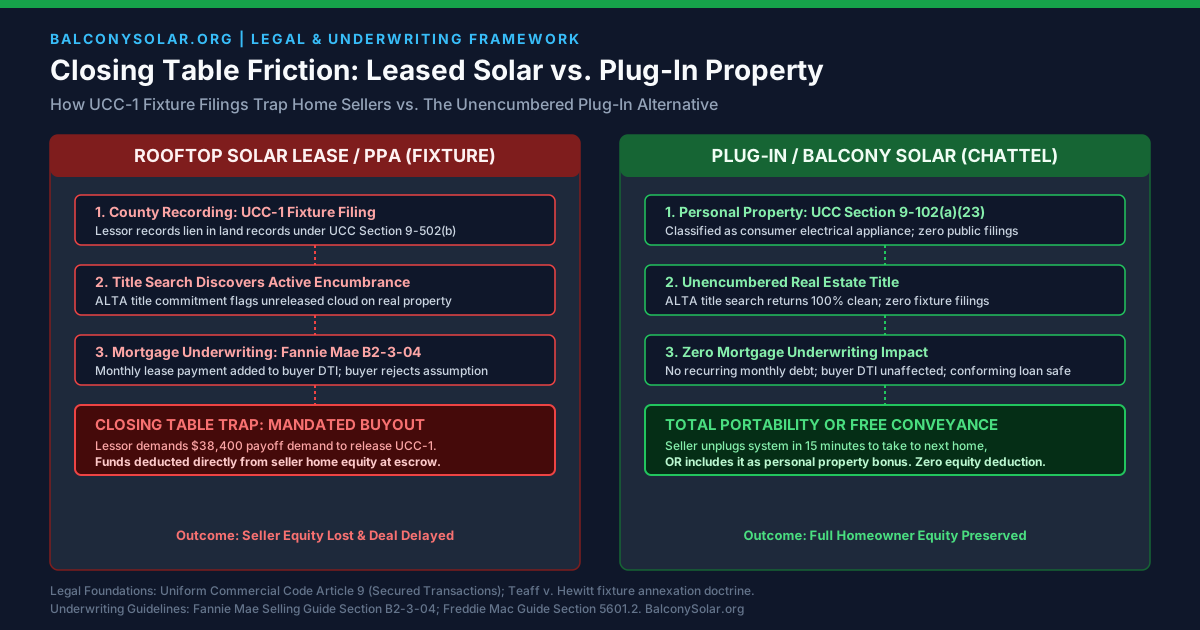
- Mortgage Underwriting Rejection: Conforming loan guidelines under Fannie Mae Selling Guide Section B2-3-04 require lenders to add solar payments to buyer debt-to-income ratios. Under CFPB Qualified Mortgage regulations and standard 43% DTI ceilings, mortgage rates of 6.5% to 7.5% per Freddie Mac Section 5601.2 and benchmark REQ-DTI-001 cause automatic loan denials.
- Title Insurance Defect: Title examiners discover a recorded UCC-1 financing statementA legal notice filed by a creditor to declare a security interest on personal property or fixtures in county land records. in county land books. Because purchase-money lenders require first-priority title, transactions stall until the lessor issues a formal release.
When buyers refuse assumption and lenders demand clear title, solar companies demand immediate contract payoffs. In Foley’s documented transaction, this buyout cost $38,400. Escrow deducted the entire fee from seller home equity.
The Legal Mechanism: UCC-1 Fixture Filings and Real Property Clouds
Why does a solar contract recorded by an equipment vendor cloud real estate title? The Uniform Commercial Code governs goods affixed to real property.
Fixtures vs. Personal Property under UCC Article 9
Under statutory provisions codified in UCC Section 9-102(a)(41), fixtures are goods so related to real property that an interest arises under real property law. This classification builds upon the fixture test established in Teaff v. Hewitt, 1 Ohio St. 511 (1853):
- Actual Annexation: Physical annexation to the realty, such as lag bolts penetrating roof rafters.
- Application or Adaptation: Adaptation of equipment to the specific use of the real estate.
- Intention of Annexation: Objective intent to make equipment a permanent accession to the freehold.
Because rooftop solar arrays require structural roof attachments, conduit penetrations, and service panel wiring, title examiners treat rooftop arrays as fixtures.
County Land Recording under UCC Section 9-502(b)
To protect collateral against subsequent mortgage lenders, solar leasing companies record UCC-1 fixture filings in county clerk land records under UCC Section 9-502(b). Under UCC Section 9-334, perfected fixture filings establish priority over subsequent real estate encumbrances.
Although lease contracts label panels as lessor personal property, county filings attach directly to the parcel legal description. ALTA title commitments flag fixture filings as Schedule B title exceptions. Lenders require full release before closing.
Mortgage Underwriting Friction: Fannie Mae B2-3-04 and Freddie Mac Section 5601.2
Homeowners often assume solar leases are private contracts that mortgage lenders ignore. Federal lending guidelines strictly forbid this assumption.
Under Fannie Mae Selling Guide Section B2-3-04, lenders issuing conforming mortgages must enforce three core rules:
- DTI Inclusion: Monthly lease or PPA payments must enter borrower recurring debt to calculate their debt-to-income ratioThe percentage of a borrower gross monthly income dedicated to paying recurring debts, strictly capped by mortgage underwriting guidelines..
- Lien Subordination or Release: Solar providers must subordinate fixture filings to first mortgages or release them entirely.
- Damage Liability: Contracts must hold borrowers harmless for property damage if vendors repossess panels.
Freddie Mac Guide Section 5601.2 enforces matching underwriting rules. When prevailing mortgage rates hovered near 3% in 2021, buyers had sufficient income headroom. Under current benchmark rates of 6.5% to 7.5% per Freddie Mac Primary Mortgage Market surveys and REQ-FIN-001, debt-to-income ratios face extreme pressure.
A $150 to $250 monthly solar payment reduces buyer mortgage capacity by $20,000 to $35,000. Buyers routinely require sellers to extinguish solar leases before settlement.
Escalator Economics: The 2.9% Compounding Cost Curve
Solar leases commonly feature an annual payment escalator, often set at 2.9% per year. Marketed as minor inflation adjustments, compounding escalators create heavy long-term liabilities.
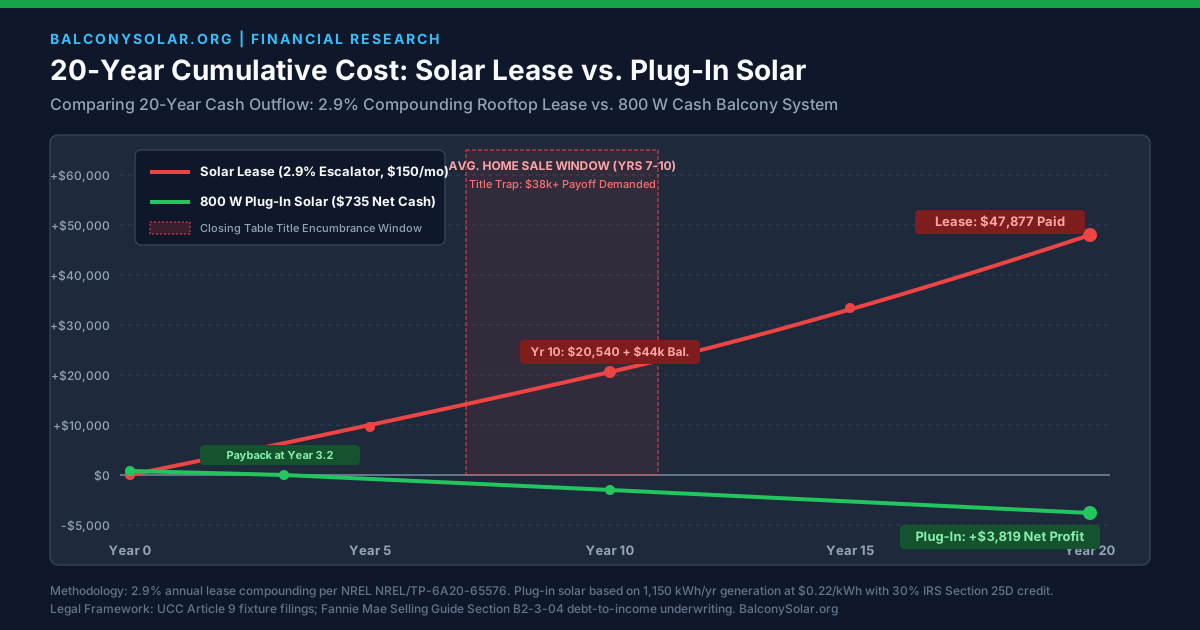
Technical research in NREL technical report NREL/TP-6A20-65576 models residential solar financing structures. A baseline lease starting at $150.00 monthly with a 2.9% compounding escalator produces this cash schedule:
| Contract Year | Monthly Payment | Annual Cash Outflow | Cumulative Cash Paid | Approximate Early Buyout Liability |
|---|---|---|---|---|
| Year 1 | $150.00 | $1,800.00 | $1,800.00 | $52,800.00 |
| Year 2 | $154.35 | $1,852.20 | $3,652.20 | $50,948.00 |
| Year 3 | $158.83 | $1,905.91 | $5,558.11 | $49,042.00 |
| Year 5 | $168.21 | $2,018.57 | $9,537.49 | $45,042.00 |
| Year 7 | $178.11 | $2,137.33 | $13,745.22 | $40,780.00 |
| Year 10 | $194.01 | $2,328.16 | $20,540.23 | $33,960.00 |
| Year 15 | $223.83 | $2,685.91 | $33,232.84 | $20,890.00 |
| Year 20 | $258.22 | $3,098.67 | $47,877.08 | $5,650.00 |
| Year 25 | $297.89 | $3,574.69 | $64,771.07 | $0.00 (Matured) |
Over 20 years, homeowners pay $47,877.08 in cash. Over 25 years, payments reach $64,771.07.
During Years 7 to 10, when typical homeowners sell, remaining lease liability totals $33,960 to $44,231. Because vendors discount future cash streams at conservative discount rates, buyout demands mirror remaining payments, trapping seller home equity.
The Hidden Traps: Detach/Reset Fees and Forfeited Tax Credits
Beyond title clouds and escalators, third-party solar introduces two major financial penalties:
1. Roof Replacement Detach and Reset Fees
Asphalt roofs last 20 to 25 years, matching solar lease terms. Roofs beneath arrays inevitably require repair or replacement during the contract.
Because third parties own the equipment, homeowners cannot hire roofing contractors to move panels without voiding warranties. Homeowners must pay solar vendor crews to detach and reinstall equipment.
Industry detach and reset fees range from $3,000 to $8,000. Homeowner insurance rarely covers these fees without covered storm damage.
2. Forfeiture of Federal Tax Credits: Section 25D vs. Section 48
Under IRS clean energy rules and REQ-TAX-001, 26 U.S.C. Section 25D provides a 30% clean energy credit for systems owned by residential taxpayers.
Critically, 26 U.S.C. Section 25D requires homeowner equipment ownership. Leased systems yield zero homeowner tax credits. Instead, commercial leasing corporations claim the 30% Investment Tax Credit under 26 U.S.C. Section 48, paired with five-year accelerated MACRS depreciation. Vendors retain lucrative tax benefits while customers shoulder real estate title risks.
The Personal Property Solution: Plug-In Balcony Solar as Unencumbered Chattel
Plug-in balcony solar provides an unencumbered alternative. By structuring generation as personal property rather than real estate fixtures, small-scale systems eliminate title liabilities.
Personal Property Classification under UCC Section 9-102(a)(23)
Plug-in solar uses one or two photovoltaic panels and a utility-interactive microinverter certified under UL 1741. Systems connect directly to existing wall receptacles through standard power cords.
Under UCC Section 9-102(a)(23), plug-in solar qualifies as consumer goods. Applying Teaff v. Hewitt confirms the distinction:
- Zero Annexation: Removable brackets or patio stands secure panels without roof penetrations.
- Complete Portability: Systems unplug in 20 minutes and move in standard vehicles.
- No Permanent Intent: Hardware functions like a portable refrigerator or window air conditioner.
Because plug-in systems are not fixtures, vendors cannot record county land liens. Title searches return clean.
Zero Impact on Mortgage Underwriting and Conveyance
Plug-in solar provides three major financial advantages:
- Zero Recurring Debt: Systems cost $500 to $1,500 cash. Zero debt payments protect borrower DTI under Fannie Mae Selling Guide Section B2-3-04.
- Rapid Capital Payback: Generating 1,000 to 1,200 kWh annually saves $220 to $260 at $0.22/kWh. Applying the 30% credit under IRS clean energy guidance and REQ-TAX-001 cuts net costs to $735, yielding a 3.2-year payback and decades of profit.
- Simple Conveyance: Sellers easily unplug systems when moving or gift them as unencumbered chattel bonuses.
Read our guides on adding balcony solar to an existing solar system, renter permission requirements, and rooftop solar vs. plug-in permitting.
Comprehensive Pros and Cons Matrix
Compare rooftop solar lease agreements against self-owned plug-in solar kits:
| Factor | 20-25 Year Rooftop Solar Lease / PPA | 800 W Plug-In Balcony Solar System |
|---|---|---|
| Upfront Capital Cost | $0 upfront (promotional pitch) | $500 to $1,500 (one-time purchase) |
| Legal Classification | Fixture (UCC § 9-102(a)(41)) | Personal Property Chattel (UCC § 9-102(a)(23)) |
| County Title Encumbrance | UCC-1 Fixture Filing recorded against real property title | Zero public recording; 100% clean title |
| Home Sale Closing Impact | High risk: Buyer rejection, $30k+ buyout demands, delayed closing | Zero title friction; unplug and take, or convey freely |
| Mortgage DTI Inclusion | Monthly lease payment counted against buyer DTI (Fannie Mae B2-3-04) | Zero monthly debt; zero DTI impact |
| 20-Year Cumulative Cost | $47,877+ (under NREL NREL/TP-6A20-65576 2.9% escalator) | $735 net initial outlay ($0 ongoing) |
| Payback Period | Never owned; perpetual payment liability | 3 to 4 years to full cash amortization |
| Federal Tax Credits | Claimed by lessor via 26 U.S.C. Section 48 | Retained by owner (30% via IRS Section 25D) |
| Roof Penetrations & Integrity | 30 to 60 roof penetrations; risks voiding roof warranties | Zero roof penetrations; railing, patio, or ground mount |
| Re-Roofing Detach/Reset | $3,000 to $8,000 mandatory fee paid to solar lessor | Free; unclip and set aside in 15 minutes |
| Portability / Moving | Non-portable; permanently attached to structure | Portable; relocates in standard passenger car |
| Equipment Safety Standard | UL 1741 utility-interactive rapid shutdown inverter | UL 1741 microinverter with automatic anti-islanding |
Summary and Buyer Checklist
Rooftop leases helped early adopters when solar cost $10 per watt. With modern equipment costs under $0.30 per watt, 25-year leases create unnecessary real estate encumbrances.
Follow this checklist before signing solar contracts:
- Demand UCC-1 Terms in Writing: Confirm whether vendors record fixture filings in county land records.
- Review Buyout Formulas: Verify Year 5, 7, and 10 buyout formulas before signing.
- Check Detach Fees: Insist on written fee caps for panel removal during roof maintenance.
- Evaluate Personal Property: Consider portable plug-in solar kits to avoid real estate title encumbrances.
Distributed solar should generate clean power–not a $38,000 lien at your settlement table.