
Direct Answer (TL;DR)
Yes, balcony solar produces electricity on north-facing and shaded railings, but annual energy yield drops to roughly one-third of an unshaded south setup, as documented in NREL PVWatts modeling. In the Northern Hemisphere, north vertical panels receive direct sunlight only near the summer solstice, generating power primarily from diffuse atmospheric light and ground reflection.
A standard 800 W dual-panel array on a north railing delivers 40 W to 120 W during daylight hours, yielding roughly 250 kWh to 380 kWh annually. While lower than south-facing baseline systems, this output offsets continuous household base loads including Wi-Fi routers, refrigerators, and standby electronics. Pairing half-cut cell panels with independent dual-MPPT microinverters prevents partial shading from disabling your entire array.
Most solar guides assume every homeowner possesses an unshaded, south-facing roof tilted at a textbook 30-degree angle.
For apartment tenants and condominium owners, real architecture looks very different.
Your apartment balcony might face due north toward a city courtyard. A higher balcony slab might cast an overhead shadow across your railing. Or nearby trees and neighboring apartment towers might block direct sunlight for half the day.
Buyers often assume non-south railings cannot run plug-in solar. Many worry microinverters will stay dark or output will drop to zero.
The reality depends on solar physics. Solar modules generate electricity from light, not direct heat.
This engineering guide examines how photovoltaic cells harvest diffuse light, quantifies real energy losses across orientations, explains shading mechanics, and provides practical methods to maximize production on compromised railings.
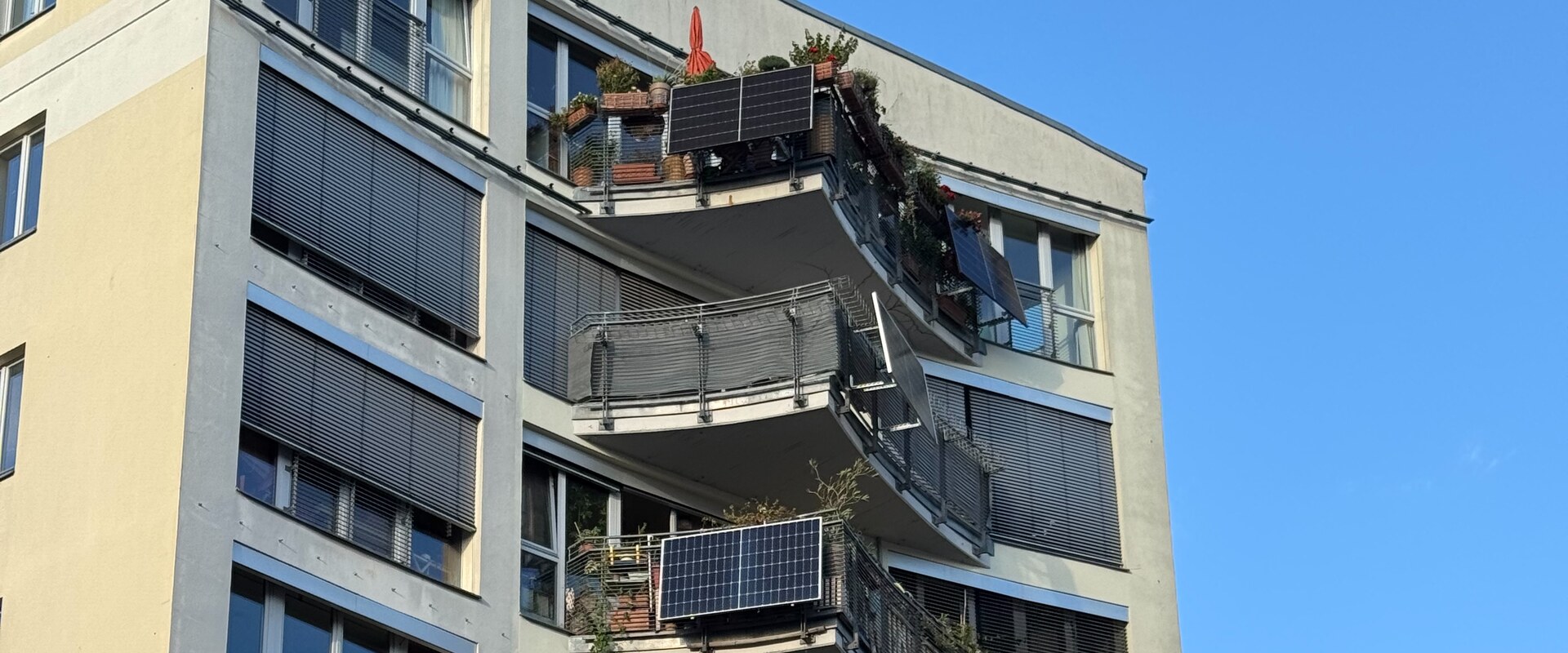 Urban balcony railings face varied directional orientations and building shade.
Understanding diffuse light harvesting helps renters evaluate realistic generation.
Photo: BalconySolar.org.
Urban balcony railings face varied directional orientations and building shade.
Understanding diffuse light harvesting helps renters evaluate realistic generation.
Photo: BalconySolar.org.
1. Direct beam versus diffuse sky radiation
Evaluating a shaded or north railing requires distinguishing three solar irradiance components:
- Direct Normal Irradiance (DNI)Direct Normal Irradiance (DNI)Solar radiation traveling in a straight line from the sun to the surface of the earth without atmospheric scattering.NREL Solar Radiation Basics →: Sunlight traveling in an unscattered, straight line from the solar disk. This beam casts sharp shadows and provides peak irradiance up to 1,000 W/m² at solar noon.
- Diffuse Horizontal Irradiance (DHI)Diffuse Horizontal Irradiance (DHI)Sunlight scattered by air molecules, aerosols, water vapor, and clouds across the entire atmospheric sky dome.NREL Atmospheric Optics →: Sunlight scattered across the blue sky dome. Diffuse light hits panels from every angle simultaneously, even on overcast days or north-facing walls.
- Ground Albedo RadiationGround Albedo RadiationSunlight reflected upward onto panels from ground surfaces, concrete patios, light-colored walls, and parking lots.PVWatts Albedo Factor →: Sunlight reflected upward from adjacent surfaces, such as light-colored concrete walkways, bright balcony floor tiles, or pale exterior stucco.
In the Northern Hemisphere, south-facing vertical panels capture both direct beam sunlight and diffuse ambient sky light.
North-facing vertical panels receive zero direct-beam sunlight for roughly nine months of the year. Around the summer solstice from late May through July, sunrise and sunset points shift north of due east and due west. This allows early morning and late afternoon sunlight to graze north walls at shallow angles.
For the rest of the year, north-facing balcony panels operate entirely on diffuse sky light and surface reflections.
[Direct Sunlight (1,000 W/m²)] ---> Strikes South Balcony Directly
               |
      Scattered by Atmosphere
               v
[Diffuse Sky Light (100-250 W/m²)] ---> Strikes North Balcony from all directions
               +
[Reflected Ground Albedo] ---------> Bounces upward from concrete courtyard
On bright days, diffuse irradiance delivers 100 W/m² to 250 W/m² of photon energy. Under NREL PVWatts diffuse radiation modeling, modern silicon panels harvesting ambient sky light generate 40 W to 120 W of continuous electricity from an 800 W array.
Diffuse output falls below peak nameplate rating, yet production continues.
2. Real-world generation by railing orientation
How much annual electricity does each orientation produce in practice?
According to modeling data from the National Renewable Energy Laboratory PVWatts tool and the European Commission PVGIS database, railing direction determines annual energy harvest:
- South Vertical (180° Azimuth, 90° Tilt): Generates roughly 70% to 75% of a south-facing tilted roof under NREL orientation benchmarks. An 800 W array produces between 750 kWh and 950 kWh annually in moderate US solar climates. Vertical mounting excels in winter, when the sun hangs low in the southern sky (25° to 35° elevation), striking vertical panels at direct angles.
- East or West Vertical (90° or 270° Azimuth): Generates roughly 50% to 55% of south tilt benchmarks per NREL PVWatts. An 800 W array produces 500 kWh to 650 kWh annually. East panels harvest morning sunlight when households wake up, while west panels capture valuable late-afternoon power during expensive peak rate windows.
- North Vertical (0° Azimuth, 90° Tilt): Generates roughly 25% to 35% of south tilt reference yields per PVGIS diffuse modeling. An 800 W array produces 250 kWh to 380 kWh annually, depending on regional cloud cover and local courtyard reflectivity.
- Partially Shaded South Balcony (Overhang or Trees): Typically yields 45% to 65% of full sun output (roughly 400 kWh to 600 kWh annually), depending on whether shade falls horizontally or vertically across the cells.
+-----------------------+---------------------+-----------------------+----------------------+
| Balcony Orientation   | Relative Yield (%)  | Annual Output (800W)  | Primary Light Source |
+-----------------------+---------------------+-----------------------+----------------------+
| South Vertical (180°) | 70% - 75%           | 750 - 950 kWh/year    | Direct beam + diffuse|
| East / West (90/270°) | 50% - 55%           | 500 - 650 kWh/year    | Morning / evening sun|
| South + Upper Overhang| 45% - 65%           | 400 - 600 kWh/year    | Intermittent beam    |
| North Vertical (0°)   | 25% - 35%           | 250 - 380 kWh/year    | Pure diffuse + albedo|
+-----------------------+---------------------+-----------------------+----------------------+
Calculate your projected generation based on state utility rates with our Household Sizing Simulator or review our guide on what balcony solar costs and offsets.
3. The microinverter startup threshold
A widespread concern among apartment renters is whether a microinverter will even turn on without direct sunlight.
Grid-tied microinverters contain precision power electronics requiring minimum electrical thresholds to initialize:
- Startup Voltage: A quality microinverter (such as models from Hoymiles, APSystems, Enphase, or TSUN) requires an input startup voltage between 16 V and 22 V DC.
- Operating Voltage Range: Once awake, the onboard tracker operates down to roughly 16 V DC and up to 60 V DC.
- Minimum Power Threshold: The inverter needs only 5 W to 10 W of active direct current per channel to initiate grid synchronization.
Solar panel voltage depends primarily on daylight intensity, not intense direct heat. Under diffuse light on an overcast day or north-facing wall, a standard 400 W panel still produces 30 V to 38 V of open-circuit voltage. That easily clears the 22 V startup threshold.
What drops in low light is electrical current (amperage), which scales directly with photon volume.
Because voltage remains high, your microinverter wakes up at dawn and stays operational until dusk, converting diffuse ambient light into grid-synchronized AC electricity all day long.
4. How shading works: bypass diodes and half-cut cells
In traditional solar arrays, shading a single cell could disable an entire module.
Traditional silicon panels connect cells in series, like old holiday lights. If one cell falls into shadow, its internal electrical resistance spikes. It stops generating power and begins consuming power produced by neighboring cells, converting electricity into concentrated heat.
Modern balcony solar modules prevent this failure using two engineering breakthroughs:
1. Half-cut cell architecture
Modern monocrystalline modules split standard rectangular solar cells into two halves. A 400 W module typically contains 108 half-cut cells divided into two parallel halves.
Because the upper and lower halves operate in parallel electrical circuits, shading the top half of the panel leaves the bottom half operating at full capacity. The panel output drops by half rather than collapsing to zero.
2. Bypass diodes
Within each panel, manufacturer junction boxes incorporate three bypass diodesBypass DiodeAn electrical semiconductor valve that diverts current around shaded or damaged cell strings to prevent hot-spot damage.NREL Cell Reliability Studies →. These diodes act as automatic one-way bypass valves.
When a shadow covers a specific group of cells, their voltage reverses. The bypass diode activates and routes electrical current around the shaded segment, allowing the remaining unshaded cell strings to continue exporting power safely.
[Unshaded Half: 100% Current Flow] ========> To Microinverter
                                                  ^
[Shaded Half: Bypass Diode Diverts Current] =====/
3. Dual independent MPPT trackers
In a balcony solar kit, panel pairing matters just as much as internal cell geometry.
High-quality 800 W microinverters feature two independent MPPTMaximum Power Point Tracker (MPPT)Microprocessor circuitry that continuously adjusts electrical impedance to harvest peak power from each individual panel.NREL MPPT Overview → inputs. Each panel operates on its own dedicated optimization channel.
If a concrete pillar or balcony partition shades Panel 1, Panel 2 continues pumping full unshaded wattage into your household wiring. The shaded panel never drags down the production of the sunny panel.
5. Overcoming balcony overhangs and upper floor slabs
For apartment dwellers with south-facing balconies, the most common shading obstacle is not trees. It is the balcony directly above them.
Upper-floor concrete slabs create distinct seasonal shade patterns:
- Summer Solar Noon (June 21): The sun climbs to a high solar elevation angle (65° to 75° above the horizon in most of the continental United States). The upper balcony floor acts like an awning, casting a deep shadow over your railing. Flush-mounted panels receive direct sunlight only during early morning and late afternoon.
- Winter Solar Noon (December 21): The sun drops to a low solar elevation angle (25° to 35° above the horizon). The low-angle winter sunlight shines directly beneath the upper balcony ceiling, striking vertical panels at direct angles throughout midday under NREL solar position data.
Summer Sun (High Angle 70°)   \  Upper Balcony Slab Casts Deep Shadow Below
                               \_______
                               |      |
                               |  [X] | <-- Panel in Summer Shade
                               +------+

Winter Sun (Low Angle 30°)   -------> Shines directly under upper slab
                               _______
                               |      |
                               |  [*] | <-- Panel in Direct Winter Sunlight!
                               +------+
This seasonal pattern creates a surprising benefit: balcony solar under an overhang provides balanced year-round generation. While summer output is reduced by midday overhang shade, winter production remains strong right when household lighting and heating demand peak.
To improve summer yield beneath an overhang, use adjustable tilt brackets that pitch panels outward by 15 to 30 degrees. Tilting moves the panel face outward into open sky, reducing overhang shadow hours.
6. Practical strategies to maximize low-light yield
If your balcony faces north, east, or suffers significant urban shading, four engineering strategies boost energy harvest:
Strategy 1: Overpanelling (pair higher DC wattage with an 800 W inverter)
In low-light conditions, panel efficiency remains high, but total incoming photon energy is low.
You can compensate by oversizing your DC solar array. Instead of pairing two 400 W panels (800 W total) with your 800 W microinverter, install two 550 W panels (1,100 W total) or four compact panels wired into dual MPPT channels.
On a north-facing balcony where irradiance is only 150 W/m², a standard 800 W array generates roughly 60 W. An oversized 1,200 W array under the same diffuse conditions generates roughly 90 W to 100 W.
Overpanelling expands low-light generation per NREL oversizing benchmarks, capturing more usable watt-hours throughout cloudy days without exceeding the 800 W AC rating. Learn more in our comprehensive balcony solar overpanelling guide.
Strategy 2: Choose bifacial glass-glass panels
Bifacial solar panels feature active photovoltaic cells laminated between two sheets of transparent tempered glass. The rear glass surface absorbs light reflected from behind the railing.
On a north-facing balcony, light bounces upward from courtyard concrete, white apartment exterior walls, and reflective balcony floor tiles. Per NREL and Fraunhofer ISE bifacial study data, bifacial panels capture an extra 10% to 25% of energy from rear albedo, boosting diffuse performance without occupying extra railing space.
Strategy 3: Target continuous base load offset
Do not evaluate north-facing balcony solar against whole-home consumption. Evaluate it against your daytime vampire draw.
Every home maintains a constant electrical baseline:
- Wi-Fi router and fiber modem: 15 W to 25 W
- Refrigerator compressor cycles: 40 W to 80 W average
- Smart home hubs, cordless chargers, standby TVs: 20 W to 40 W
- Total apartment base load: 75 W to 145 W
A north-facing 800 W system producing 50 W to 100 W in diffuse daylight offsets half or more of this continuous background draw. Because household appliances consume all generated power immediately, zero electricity exports back to the utility at low wholesale buyback rates.
Read our complete financial breakdown in our balcony solar sizing and payback guide.
Strategy 4: Verify electrical outlet safety
Regardless of your railing orientation, safety standards remain identical.
Your balcony outlet must have an extra-duty while-in-use cover under NEC 406.9, functional GFCI protection under NEC 210.8, and a dedicated or lightly loaded branch circuit. Never run extension cords through window seals.
Review our safety checklist in outdoor outlet plug-in solar safety.
Frequently Asked Questions
Will balcony solar damage my microinverter if it stays shaded?
No. Shading reduces electrical current flowing through power electronics. Operating at lower current and cooler temperatures reduces thermal stress on internal MOSFETs and capacitors, extending inverter operating life compared to units baking under full desert sun.
Can I tilt north-facing panels toward the sky to capture more light?
Yes. Tilting north-facing panels back by 15 to 30 degrees opens their view to the upper sky dome. According to NREL diffuse radiation measurements, tilting captures an additional 15% to 25% of scattered atmospheric light compared to vertical mounting. Always ensure mounts are securely bolted and rated for wind uplift.
Do thin-film panels work better in shade than monocrystalline panels?
Thin-film (CIGS) panels historically handled diffuse light marginally better than older silicon modules. However, modern N-type TOPCon monocrystalline panels with half-cut cells and multi-busbars now match or exceed thin-film low-light performance while offering twice the energy density per square foot.
Calculating financial return on shaded railings
An 800 W array generating 300 kWh annually saves $60 to $90 each year at average US tariffs ($0.20 to $0.30 per kWh), per EIA retail electricity data. Standard hardware kits costing $500 to $700 achieve payback in six to nine years, well within standard 25-year manufacturer warranties.
Primary Statutory and Technical References
- National Renewable Energy Laboratory (NREL): PVWatts Calculator Technical Documentation and Diffuse Radiation Modeling, Technical Report NREL/TP-5D00-62641, 2024. NREL PVWatts Portal.
- European Commission Joint Research Centre: Photovoltaic Geographical Information System (PVGIS): Solar Radiation Matrix for Vertical Surfaces, European Commission, Ispra, 2024. PVGIS Scientific Documentation.
- Fraunhofer Institute for Solar Energy Systems (ISE): Bifacial Photovoltaics and Vertical Railing Energy Yield Assessment, Fraunhofer ISE Research Reports, Freiburg, 2023. Fraunhofer ISE Publications.
- Underwriters Laboratories (UL): UL 1741: Standard for Inverters, Converters, Controllers and Interconnection System Equipment for Use With Distributed Energy Resources, Edition 3, 2021. UL Standards Sales Directory.